
The Battle of Culloden was fought on 16 April 1746 between the King’s army, commanded by William Augustus, Duke of Cumberland, and the Jacobite army, under Charles Edward Stuart, resulting in a royal victory.
The devastating slaughter of the Jacobites was the result of half an hour of opening British cannonade. The battlefield was ill-chosen from the Jacobites’ perspective – it gave a clear field of fire to Cumberland’s artillery. The order to attack was slow to progress down the chain of command, leaving them vulnerable. In total, the battle lasted under an hour. Approximately 1,250 Jacobites were killed, with few left wounded. The government force officially lost 50 men, with 259 wounded.
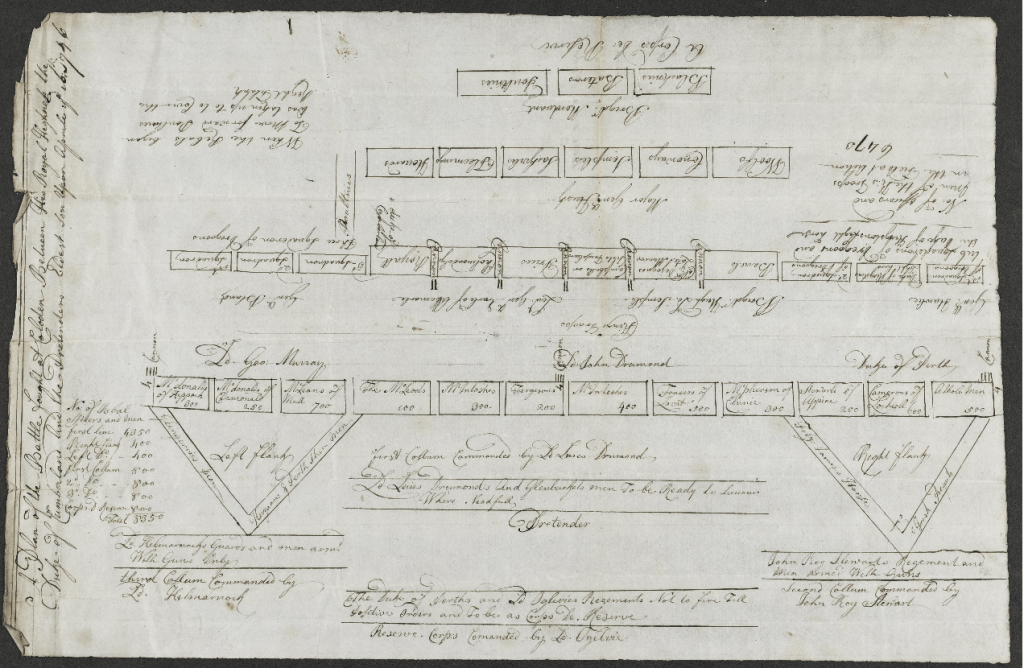
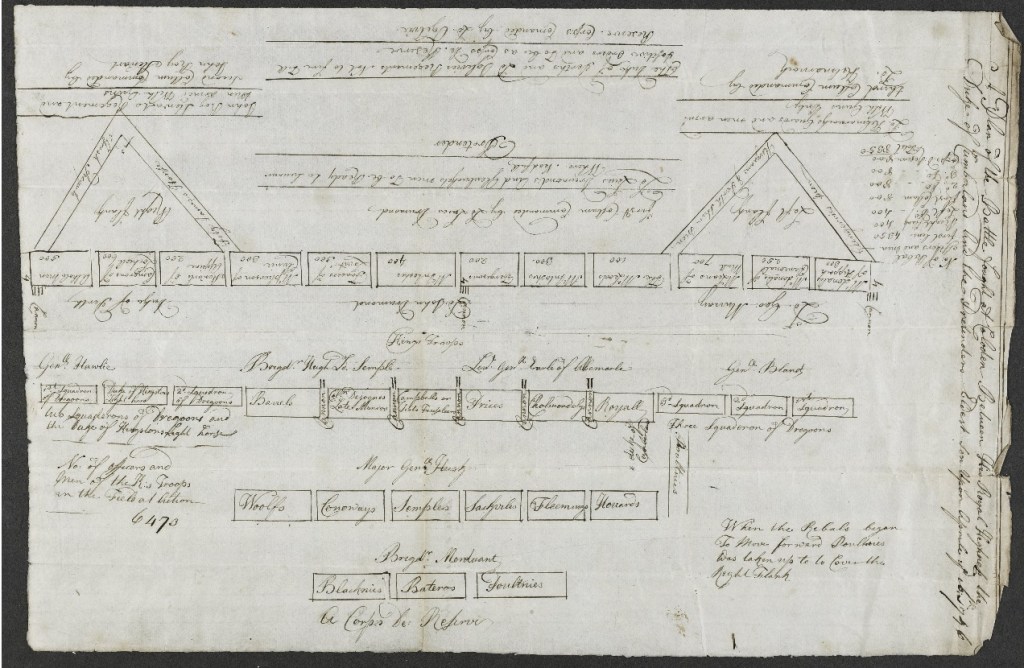
This plan shows in detail the point at which the Royal army wheeled into order of battle, just south of Castle Stuart, and towards Castle Dalcross in the south-east.
This post is the second in a series looking at some of the most striking and interesting items in the collections of National Records of Scotland. The first, on a 17th Century Gaelic eulogy, is available on Open Book. The second, about a plan of the Forth Bridge, is also available.
The text of this post is taken from Treasures of National Records of Scotland, 2025. This book is available to purchase at the Scotland’s People online shop.

