
The COVID-19 lockdown in 2020 imposed an immediate, and strict, national ban on free movement. Part of the many arrangements made to ensure that the risk of infection was controlled, was a clear message about acts of remembrance within military communities. Clear and unequivocal. For members of the Commando Constituency, the obvious restriction was that the annual gathering at the site of the Commando Memorial in Lochaber wouldn’t take place. Thoughts turned to what a virtual gathering would look like. Could it be arranged?
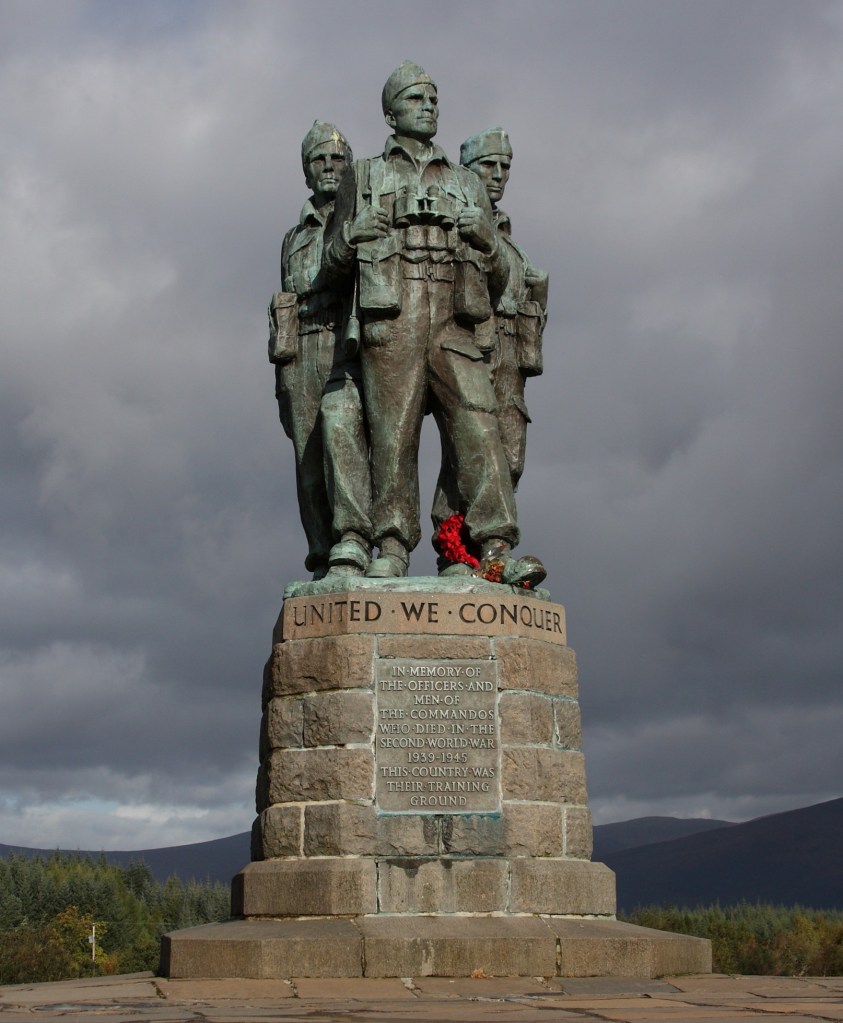
Thoughts also turned to acknowledging the sculptor responsible for the iconic statue, The Three Men on the Hill’. Scott Sutherland ARSA (1910 – 1984) had won a competition for the design in 1951, a design that is now a Category A Listed monument and a totem for acts of gathering and remembrance. It is also a recognised tourist attraction with an estimated footfall in excess of 20,000 annually. The Commando Memorial is very well known but Scott Sutherland less so. Why not do something to address that information gap? So a four-man committee was formed to celebrate his enduring legacy and provide some overdue recognition of his life and work.
The Scott Sutherland Project
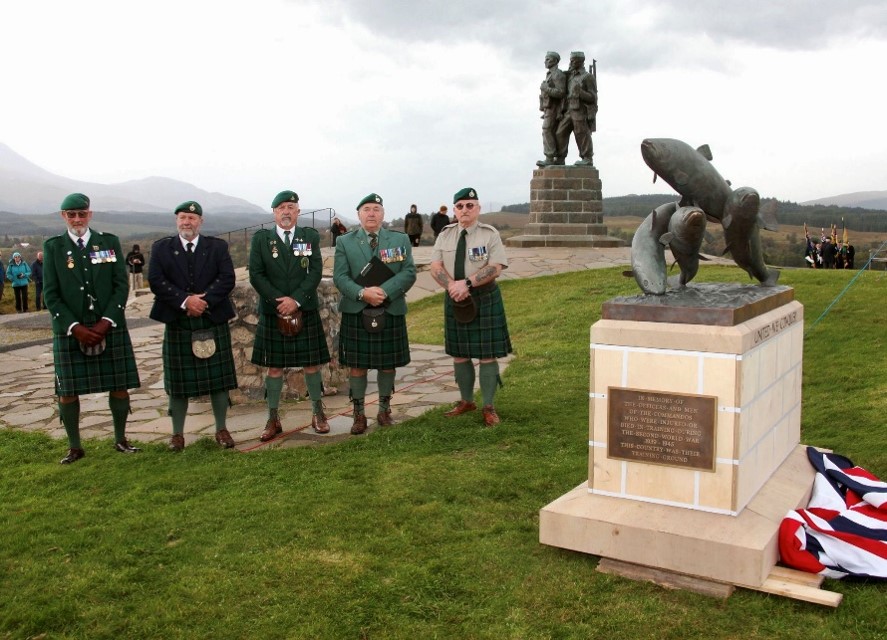
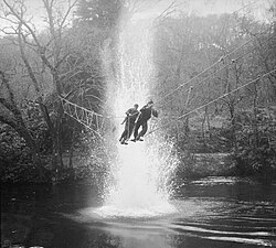
Part of the Scott Sutherland Project was to recommission a ‘lost’ statue of Sutherland’s, The Leaping Salmon, and dedicate it to the memory of Commando trainees killed and injured during wartime training. This training was designed to be realistic and hazardous. Using live ammunition and explosives and operating in the rugged Highland landscape and lochs, often at night, resulted in a high number of casualties and at least 27 fatalities.
That work for the Leaping Salmon statue was completed in September 2025 when the statue was unveiled at the site of the Commando Memorial. Pulling the lanyards of the Union flag were the guiding hands of relatives of those who had experienced the sense of loss and grief of loved ones serving at the Commando Basic Training Centre at Achnacarry.
Once the dust had settled on a very busy, and extremely wet, weekend, a recurring question was what will the project committee do next? That question was accompanied by a suggestion that more relatives needed to be made aware of the purpose of the Leaping Salmon statue and that it was dedicated to the memory of their brave fathers, husbands, and sons who were in danger of becoming forgotten ghosts. Something needed to be done. The next logical step was to research the known fatalities to determine if surviving relatives were aware of their family history and the impact it had on Great Britain during the dark days of the Second World War.
The Research
There were three obvious considerations for getting the research underway. One was the ‘need to know’ wartime requirement for secrecy. Commando training and operations were very hush–hush. A second consideration was the accuracy, or inaccuracy, of wartime record keeping and finally, the third was the exact status of trainees when they were killed or injured. The third consideration was probably the biggest obstacle to making progress.
Commandos were recruited from every regiment of the British Army and the Royal Marines. There were also two large intakes of serving policemen. These men were retained on the strength of their parent unit until Commando training was completed. Men who were unable to complete the training were ‘Returned to Unit’ (RTU’d). Most RTU’s were due to lack of fitness or on a voluntary basis. The death of a Commando trainee was the responsibility of his parent unit and not the Commando Basic Training Centre; as such, it is not always clear in the records, who participated in – or passed away during –- Commando training. Training was intentionally rigorous and physically demanding with a heavy emphasis on amphibious assaults. Drowning was a constant cause of training fatalities. The combination of wearing and carrying heavy equipment easily defeated even the strongest swimmer. It should be noted that not many of the UK population could swim.
The Commando Veterans Archive
The Commando Veterans Archive offered a very useful starting point with a database of known fatalities. Obtaining details of the many injured trainees was always going to be difficult due to the absence of accurate medical records. We started by taking the recorded details and verifying them with primary or secondary source information. This work is really the bread and butter of this research into working forwards and not backwards with the bloodline to connect the past with the present. 27 case files and 27 very different and individual stories. Using the National Records of Scotland (NRS) Scotland’s People was an obvious starting point.
You can download the current database of known fatalities below. Please note, included are the details of death such as ‘drowning’, ‘gun shot wounds’ and ‘explosion’.
Scotland’s People provides access to many records that are useful for conducting family history research, including certificates of deaths in Scotland. After 1855 it became compulsory to register deaths (as well as births and marriages) in Scotland. Each death certificate provides a great deal of useful information, including the individual’s name, profession, where and how they died, their age, sex and who registered. 26 death certificates were obtained, the missing 27th Commando trainee was an American Ranger who was killed at Barry Buddon, near Carnoustie. A second American Ranger was drowned, in 1942, adding an international dimension to the research.
Lamont Hoctel was a 25-year-old petrol attendant from South Bend, Indiana. A long way from home. Interestingly, the Rangers were billeted in Dundee with local families in 1943 and are still remembered in Dundee with great affection.
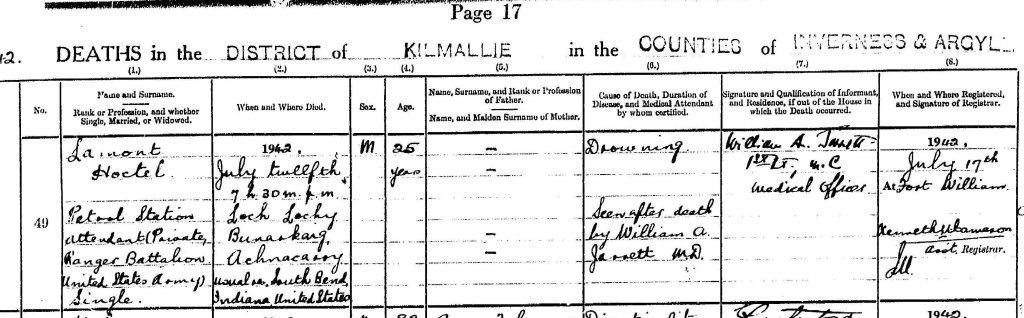
This line of research highlighted the need to verify each case, and how useful NRS records were in establishing the details and accuracy of the known fatalities.
Lance Corporal George McLean
Lance Corporal George McLean of the Seaforth Highlanders is listed on the Commonwealth War Graves Commission (CWGC) with a photo of his headstone. No family details were included in any of the CWGC paperwork. Unusually, George could not be located on Scotland’s People, using the CWGC information.
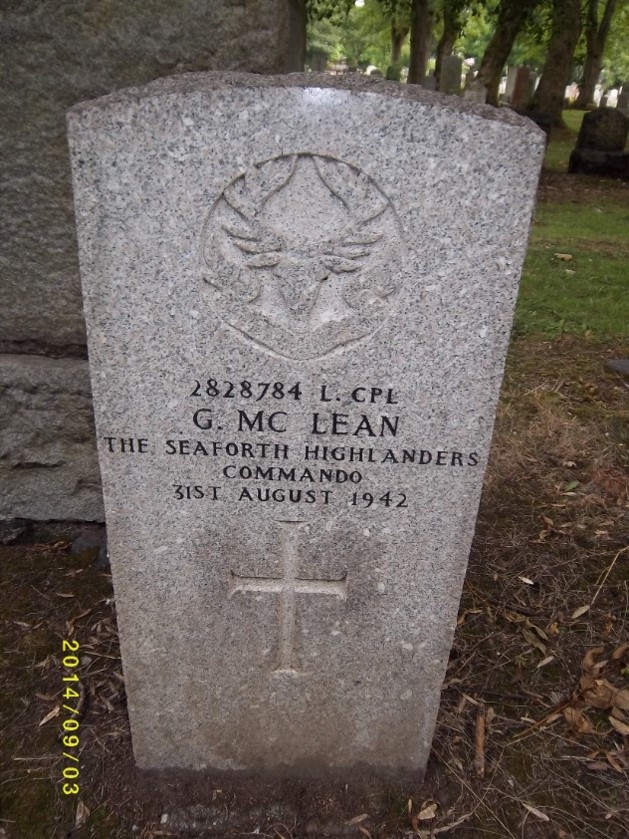
Surprisingly, some of the CWGC details were incorrect; his age was two years out and the surname was listed as McLean, not MacLean. This was enough to slow the process, but locating his death certificate put the research back on track.
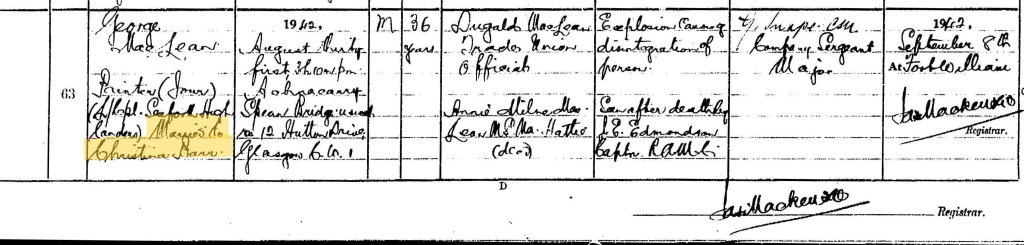
From his death certificate we determined that he was a married man which signposted us to other family members. A Facebook Family History group in Glasgow provided a great deal of family context and clarity. We know that at least one family member is alive and probably living in North Ayrshire. Making them aware is the next obvious step in George’s story. The CWGC have been informed of the typo on the headstone and NRS’ support was greatly appreciated.
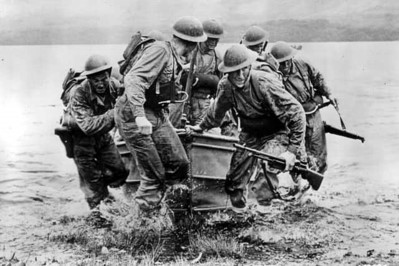
The research into Commando training fatalities, and the work of publicising their stories has become the We Will Remember Them – We MUST Remember Them project, officially launched in March 2025. Since then a baseline for each fatality has been created mainly using records available via Scotland’s People. This early work and encouraging progress can be crudely labelled as Phase One. Phase Two will focus on following the family history forward to the present day.
We are keen to promote this project and it’s aims with the hope of reaching out to the family members of these men. If this blog makes you think, ‘Does this project relate to our family? Can I check with relatives if it does?’ If you find a connection, or have information you would like to share, please use the email address at the end of this blog and reach out.
The brave young men who were killed during wartime Commando training were always so much more than a name, rank and number. They were sons, husbands, brothers, colleagues and known by many friends and neighbours. Over 80 years have passed since the dark days of the Second World War and it is time to honour their memory and to connect with the present. Through our research, we have connected with four families to remind them that their loved ones are not forgotten. The research work could add a third qualification to the project motto:
We Will Remember Them – We Must Remember Them – We DID Remember Them.
UNITED WE CONQUER
Steve Nicoll
steveknicoll@gmail.com

