
This post is the first in a series looking at some of the most striking and interesting items in the collections of National Records of Scotland.
Sir Duncan Campbell died in 1631 at the age of 81, after running the estates for 48 years. Neil MacEwan, head of the family of hereditary poets in the services of the Campbells, probably wrote this eulogy at his death.
It is one of the few Gaelic records in our collections. As Gaelic was not generally used for legal purposes, we do not hold many documents in the language.
This, however, is a magnificent example: a poem not in vernacular Gaelic but the “classical” language used for literary or learned purposes, and in the very difficult syllabic metre called Séadna. A dating stanza (“A thousand, a full thirty, six hundred and five months”) in a different metre is written in red ink all along the bottom margin. Duncan’s genealogy, also in red ink, occupies a corresponding position at the top.
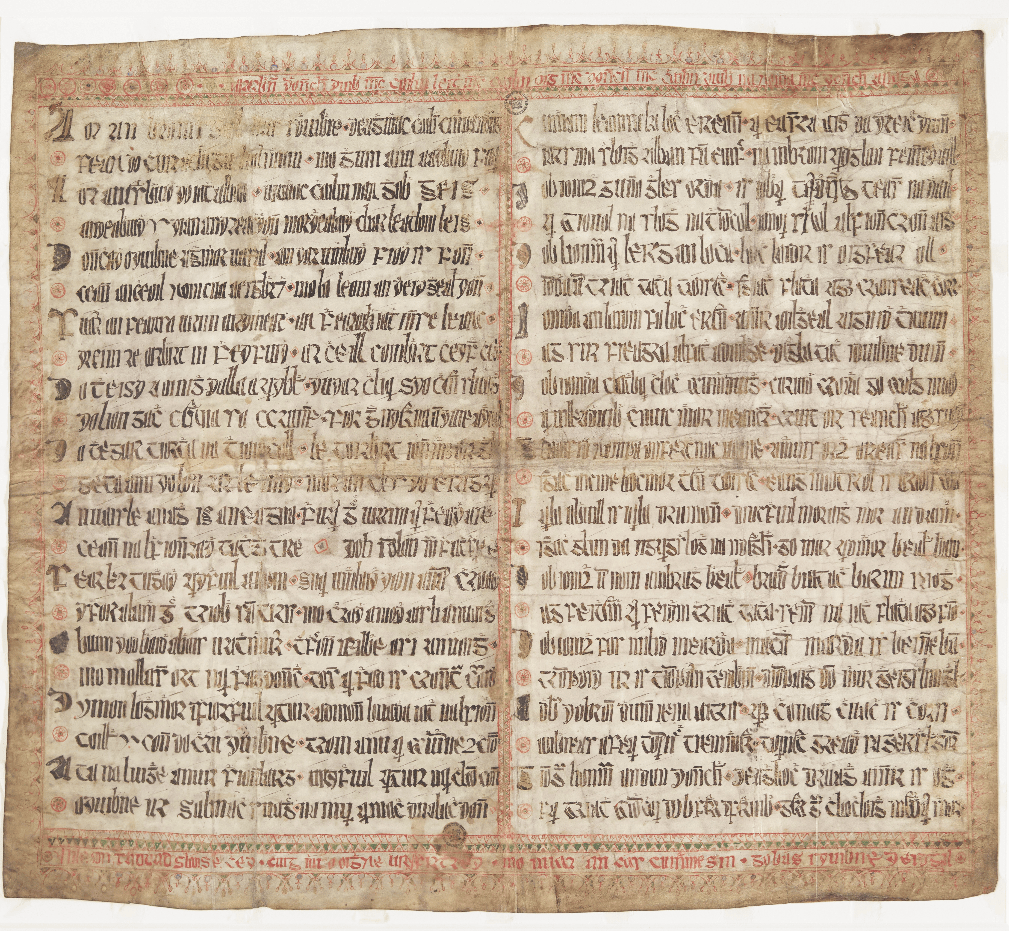
The document is a beautifully decorated presentation copy of the lament on the death of Donnchadh Dubh a’ Churraic: “Black Duncan of the Skull-Cap”, as Duncan was popularly known in Gaelic.
In the Highland bardic tradition, the poet lavishly praises the dead chief: his protection of the clan lands, his lineage going back to Diarmid O’Duibhne, the progenitor of the Campbells, his lavish generosity, his military ability and his fame – all key virtues within the Gaelic panegyric tradition.
Mór an Bróinsgél bás i Dhuibhne,
deagh mhac Cailin ceann nan drùagh …
Do thégar tìortha ‘na thiomcholl
le toirbhirt ionmhus óir ghlain …
A n-ùaisle, a n-ágh is a n-eagna
fhuair gach uirrim [ar] fheadh a ré …
Great the woe-tale, the death of Ua Duibhne,
good son of Colin, chief of the wise…
He cherished the regions round about him
by bestowing treasures of pure gold…
For nobility, for fortune and for prudence
he won all reverence throughout his life…
The eulogy came to NRS through William McFarlane of Portsburgh, a prominent Justice of the Peace.
The text of this post is taken from Treasures of National Records of Scotland, 2025. This book is available to purchase at the Scotland’s People online shop.


One thought on “Treasures of National Records of Scotland: Gaelic eulogy on Sir Duncan Campbell of Glenorchy, 1631”