
In the late 17th century, Mary Erskine was a well-reputed and successful Edinburgh businesswoman whose generosity and philanthropy has left a lasting mark on the city that was her home.
Born on 12th May 1629 in Clackmannan to Robert Erskine and Beatrix Stupard, she later moved to Edinburgh.
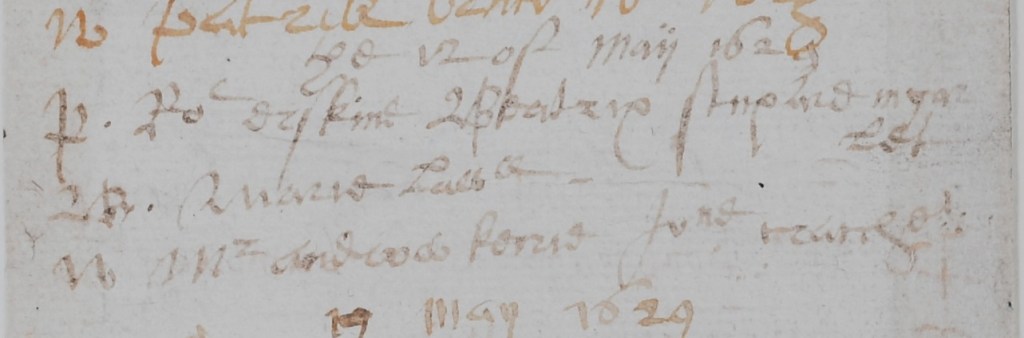
One of the earliest references to her in Edinburgh is in a collection of bills, deeds and documents relating to David Ross of Balgownie in 1660.

Mary is listed as “arbitrix [a female arbiter] to Thomas Garvin merchant burgess of Edinburgh” and handling the payments that were due to him, showing she was already considered a financially savvy and trustworthy individual. It is particularly noteworthy as the man she was betrothed to, Robert Kennedie, drafted the document, indicating that the case was being “persewed be my spouse”. He was also one of the signatory witnesses.
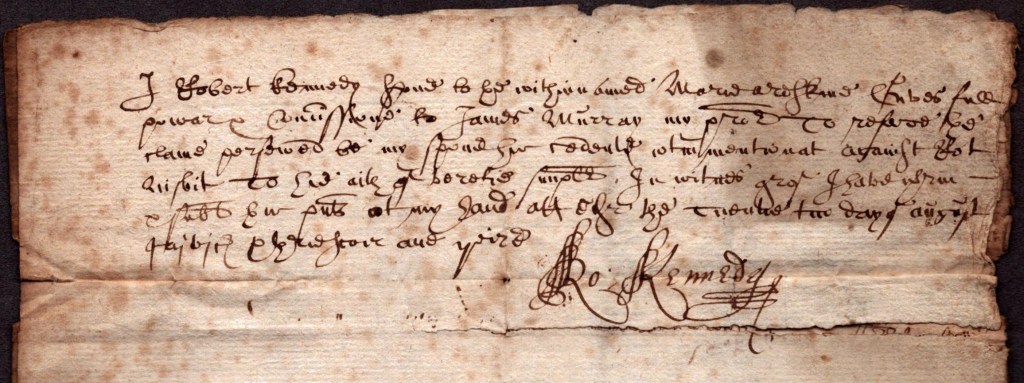
Transcription
- I Robert Kennedy spouse to the within named Marie ereskine [?] full
- Powar & Conussne to James Murray my pror[] To refuse[?] the
- Clame persewed be my spouse her cedente w[i]t[h]in mentionat against Rob
- []sbit To her aith or veretie sunplr In witness [there]of I have []rin
- & sub[scribe]t hir p[rese]nts w[i]t[h] my hand att Ed[inbu]r[gh] the Tuentie tuo day of august
- Jajvic [1600] & thriescore [60] and yeiris
- Ro Kennedy
Robert Kennedie was a Writer to the Signet – a solicitor – in the city. On 19th July 19th 1661, he and Mary were married in Edinburgh.
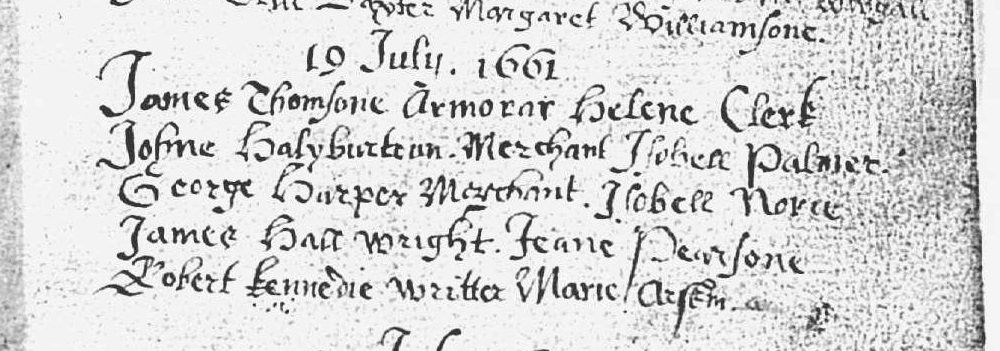
Transcription
19 July 1661
James Thomsone Armorar Helene Clerk
Johne Halyburton Merchant Isobell Palmer
George Harper Merchant Isobel Norie
James Hall Wright Jeane Pearsone
Robert Kennedie Writter Marie Arsken
Robert was also named as “the ordinar agent of Culzean” [GD25/8/676] in the employment of the Laird of Culzean in Ayrshire.
Mary and her husband had five children, though it appears that none of the children reached adulthood: Thomas (b.1662), Euphan (b. 1664), Robert (b. 1665), Mary (b. 1668), John (b. 1670). The family had ties to a particular tenement connected to Balgownie in Kirkheugh close in Edinburgh, a now-lost street that descended to the Cowgate from behind St. Giles’ Cathedral’s lost kirk yard.
In around 1670, Robert died, leaving Mary responsible for the debts he held, but in turn, she also had people who owed her money. In the Balgownie papers in 1671, she is listed as “relict of umquhill [deceased] Robert Kennedy debtor to Sir Thomas Wallace of Craigie” in a case before the Council and Session where Balgownie was ordered to pay what was due to her. [GD124/1/1166/12].
After the loss of her husband, Mary took legal action against Archibald Kennedie, the Laird of Culzean in 1680. Finding documents among her late husband’s papers indicating that Culzean owed him 215 in rent and expenses, she raised an instance “becaus she heard him say that Culzean was his debtor in Considerable soumes” [sic] [GD124/7/43]. She was unsuccessful in this instance because the papers were not dated, so the court found she did not adequately prove the allegations.
This was not the first nor last legal action she took. From 1671 onwards, she put numerous people “to the horn” i.e. declaring a debtor with unpaid debts as an outlaw. The name came from the three blasts of a horn sounded to publicly announce the person’s status. People she executed a horn against included the Lord Lyon, David Ross of Balgownie, burgesses and other leaders in politics and society.
In September 1675, Mary married for the second time in North Leith parish.
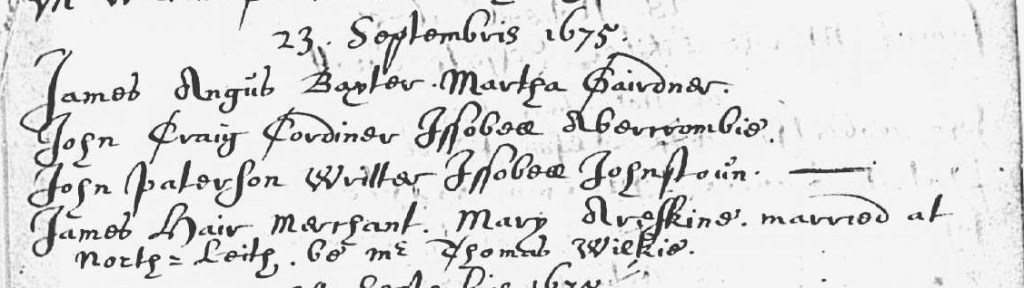
Transcription
23 Septembris 1675
James Angus Baxter Martha? Gairdner
John Craig Cordiner Isobell Abercrombie
John Paterson Writter Isobell Johnstoun
James Hair Merchant Mary Areskine married at North Leith by Mr Thomas Wilkie
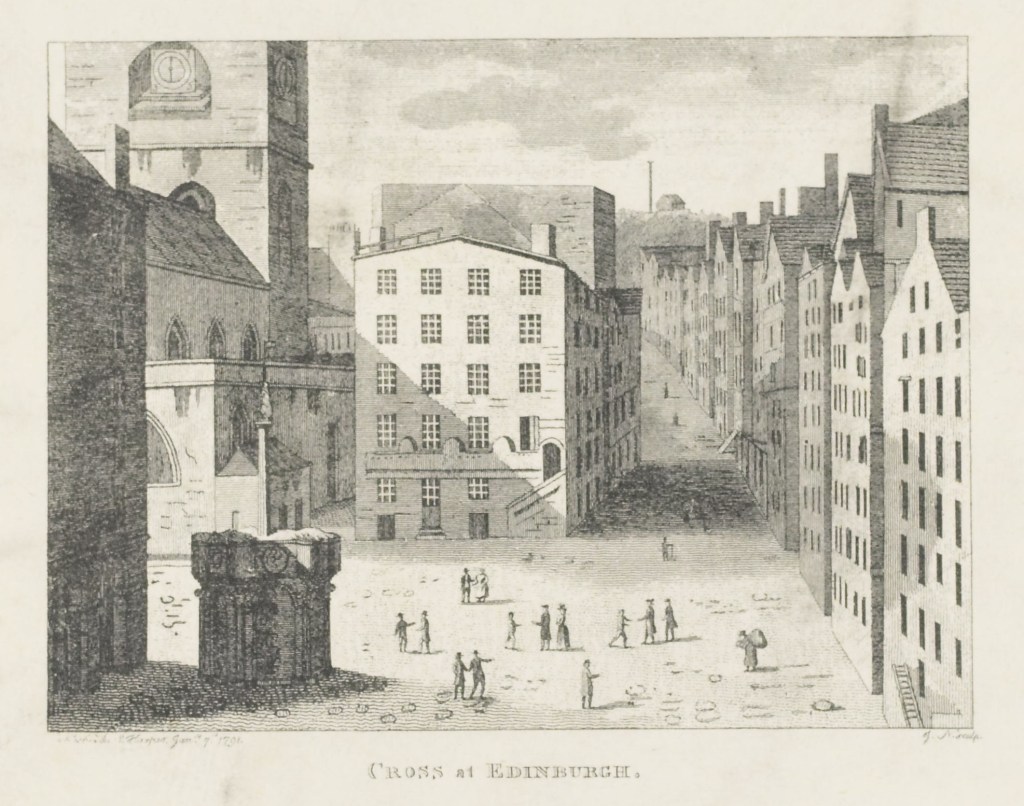
Her new husband, James Hair’s, worked as an apothecary or druggist. Together, they handled the business of their shop and correspondence was addressed “to be found at her shope at the signs of the red lyon over against the Lucken booths one the north side of the street”. Once a two-storey building, the Luckenbooths had expanded into a row of towering buildings that ran along the north side of St. Giles’ Cathedral on the Royal Mile, stretching the length of the cathedral and packed with shops and stalls.
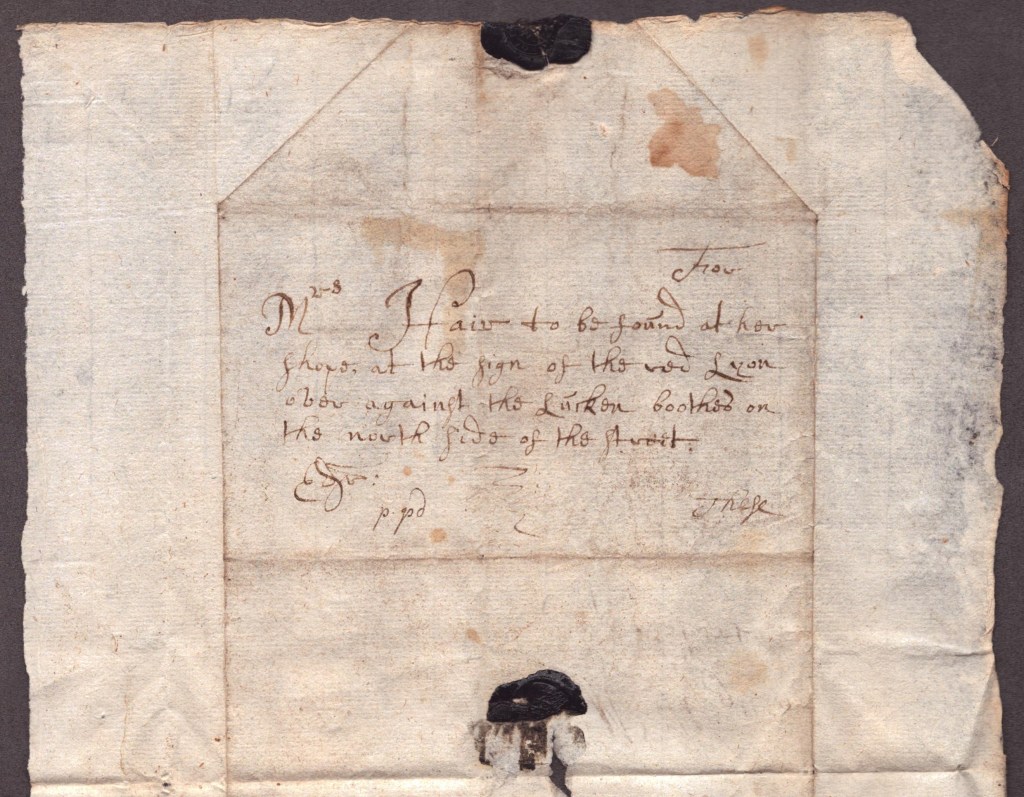
Transcription
Mrs Hair to be found at her shope at the sign of the red lyon over against the Lucken boothes on the north side of the street Edinburgh
The shop’s stock was extensive with specialist ingredients and remedies from as far afield as Asia and the Americas. These included tamarind, sassafrass, spiritus vitriol [sulphuric acid], suckus limonum [lemon juice], saltpetter [saltpetre], saffron, senna, floss sulphuris, coloquint, camomile, cinnamon, antimony, mastic and elixir proprietatis (a ‘cure-all’ elixir) [GD124/16/14]. They also carried specialist glass items for apothecaries, chemists and physicians.
Many of the pieces of correspondence relating to the shop were directed to Mary herself, including orders, lists of inventory for specific customers and receipts. Mary and her husband were also named together in several bonds and leases during their marriage [GD124/2/123], frequently named as pursuers. While some documents were submitted by “James Hair on behalf of his spouse”, others were submitted by “Mary Areskine and her spouse”.
By 1678, they were listed as the proprietors of the “tenement of land lying in the Kirkheugh on the east side”, a property which Mary disponed (sold) to Thomas Robiesone sometime after James Hair’s death [GD124/1/1166]. The paperwork is not signed or dated, so it is not clear whether the transfer of property was completed or whether it was impacted by the fire that destroyed Kirkheugh close and several other closes between St. Giles’ Cathedral and the Cowgate in 1700.
Although James died in 1683, confirmation was not granted by the Commissary Court until 1688. The settlement of his estate awarded Mary “the mert wair in his choap” and “insight and plenishing of his dwelling hous, the half belonging to the relict by the contract of mariadge”. He also left Mary with both debtors and creditors and in 1690, she wrote “I have paid this only within this twoo years or thereby with nyne hundred marks of [annual]rent thereof for non would take it out of my hand” [GD124/1/1174].
After her husband’s death, Mary maintained the shop and continued to run her own successful financial business. The Bank of Scotland was only founded in 1695 and before that, money-lending between associates, families and friends was common.
Mary and both her husbands had been borrowers and lenders in the past, with substantial amounts of money changing hands. She provided small personal loans to women, often widows, left destitute by their husband’s death or daughters who had lost their father, possibly influenced by her own experience.
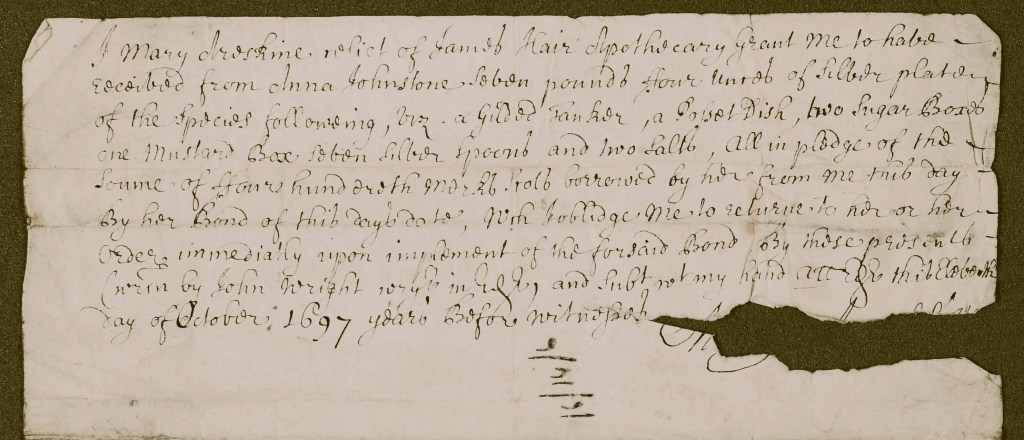
Transcription
I Mary Erskine, relict of James Hair Apothecary Grant me to have received from Anne Johnstone seven pounds four ? of silver plate of the species following, viz a Gilded Tanker, a Posset Dish, two Sugar Boxes, one Mustard Box, seven silver spoons and two salts, all in pledge of the soume of found hundredth merks ? borrowed by her from me this day By her Bond of the this day & date, ? I oblidge me to ? to her or her order immediately upon implement of the foresaid Bond by these present – witnes? by John Wright, wryter in Edinburgh, and subt wih my hand > this eleventh day of October 1697 before witnesses.
In a period when inheritance would generally pass to sons, women were often left with few resources, often objects that had been given as part of a dowry. Mary gave these women a means to borrow money directly, using valuable items such as silver dishes and tableware as collateral for small, short-term loans.
As can be seen from the many legal writs, hornings and bonds, Mary was not limited to modest loans and readily did business with the aristocracy and figures of authority. In 1702, the Earl of Melville,Lord President of the Privy Council of Scotland,and the Earl of Leven, Governor of the Bank of Scotland, “have borrowed and received from Mary Ereskine relict of the deceast James Hair burges of Edinburgh and haill the somme of sex thousand merks good” [GD26/4/329].
On top of Mary’s business practises, she also took great care of the people who were important to her. She did this by paying debts, assigning debts due to her to other people and providing gifts of money to her friends and relatives.
One such gift went to James Hair, her nephew, in 1696 “to you and yours, to uplift & to transact, and to dispose thereanent any way yow please”. Although she did also ask that he “doe nothing rashlie” since the last time she had given him such a gift, “I know not whither you have done any good either to your selfe or any other body” [GD124/1/1174].
Mary’s generosity is the reason she is remembered in Edinburgh to this day. In 1694, she mortified (bequeathed) 10,000 merks to the merchants guild to fund a maidens’ school for the daughters of merchant traders in the city.
Other such schools existed in Scotland, but only for boys. The Maiden School was the first known school to be founded to focus on the education of girls. Initially based in the Merchant’s Hall in the Cowgate, the school relocated to “lodgings, houses and yards” in Bristo, purchased from James Scott’s heirs.
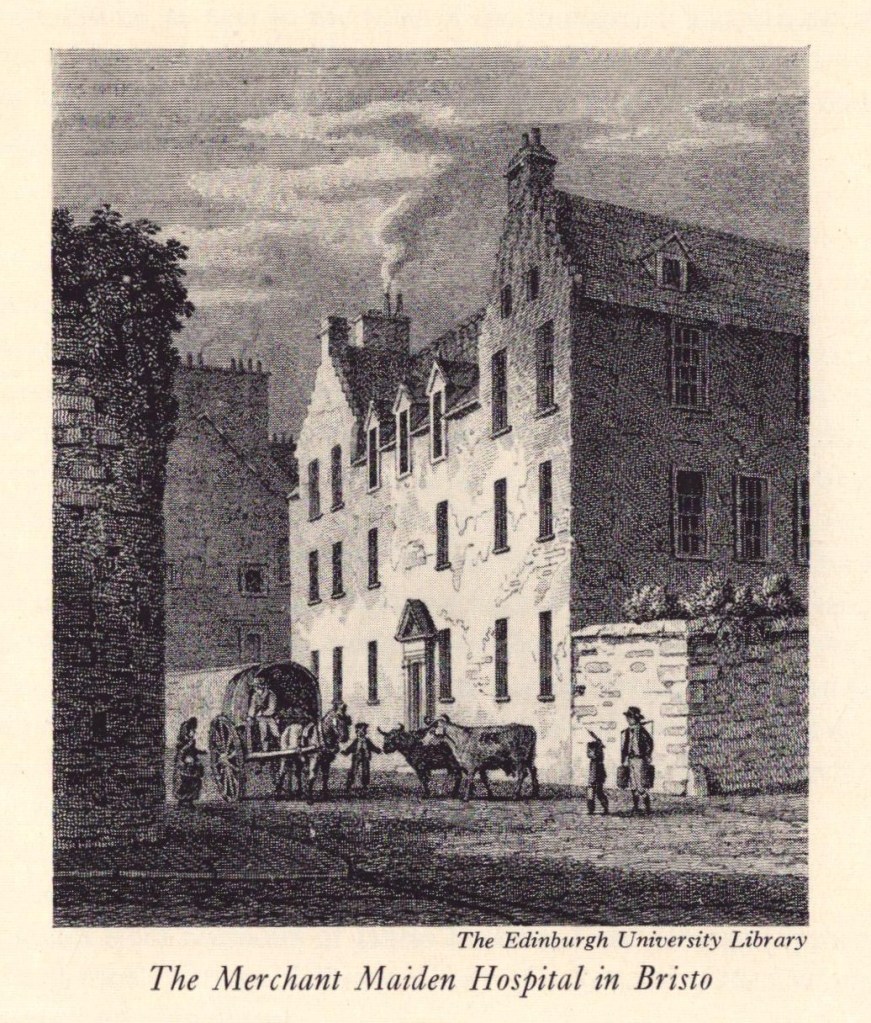
In 1707, the Merchants Guild received Parliamentary and Royal consent for “ane hospital for poor young children of the female sex” in Bristo, Edinburgh, with special acknowledgement that they had “been particularlie encouraged thereto by the worthie and charitable Mary Arsekine” [GD124/20/17/2].
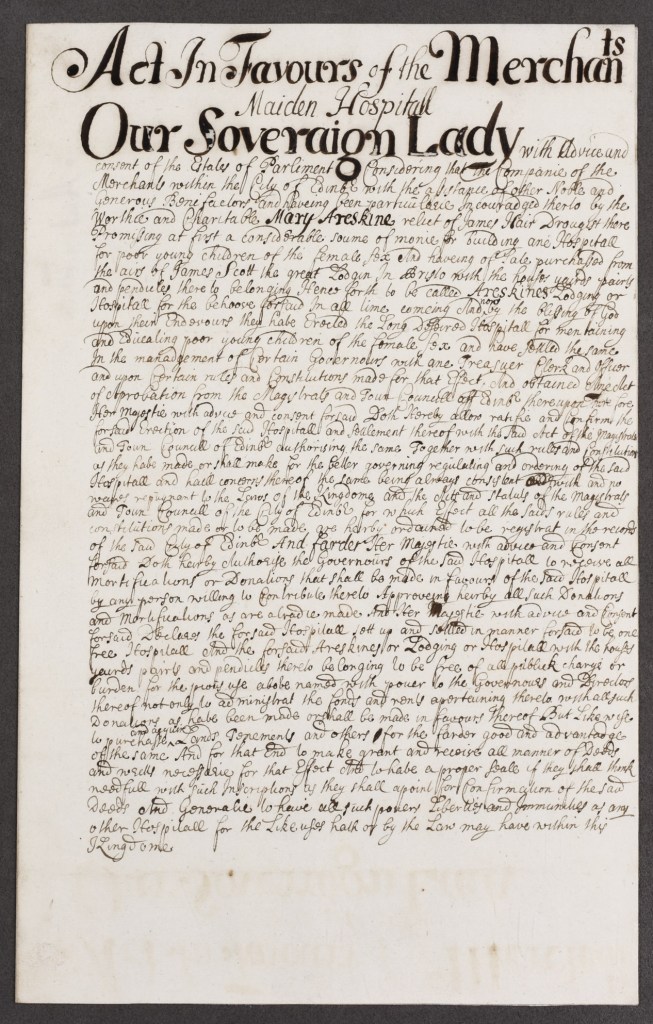
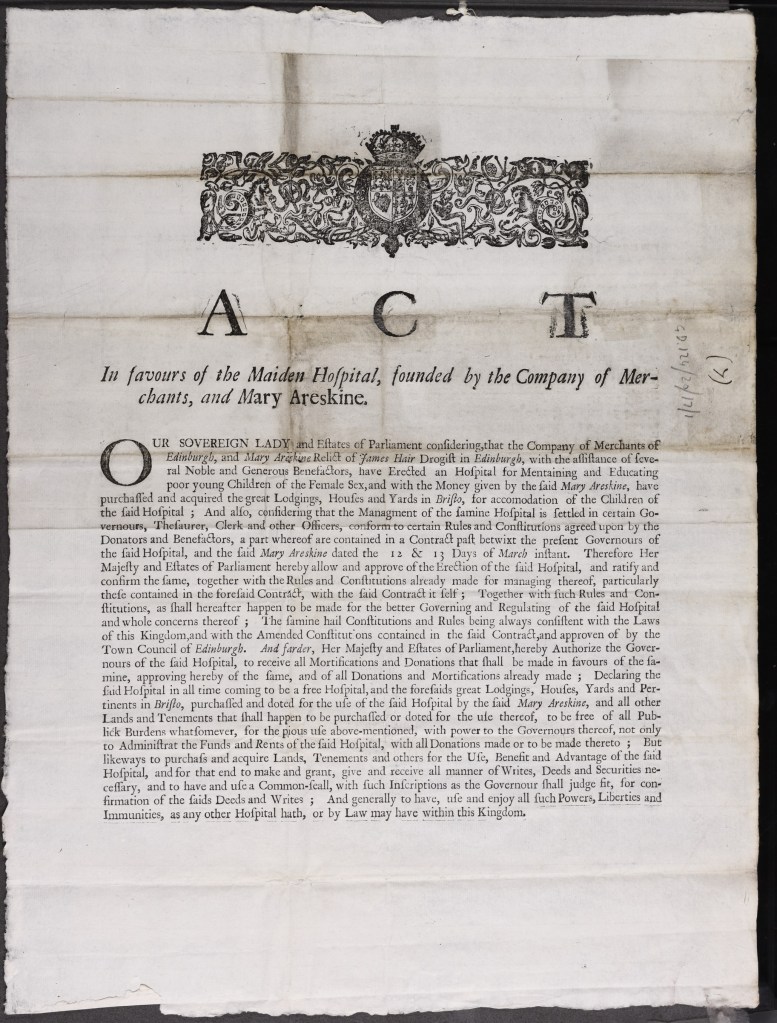
It has been relocated and expanded several times over three centuries and now can be found in Ravelston. While the Parliamentary Act stated the school was “to be called Areskine’s Lodging or Hospitall”, it went through several different titles with each new location, finally being renamed as the Mary Erskine School in 1944 to recognise the woman critical to its foundation.
In 1976, Mary Erskine’s school and Stewart Melville’s College – a private boys’ school – became collaborative partners. In 2024 – the 330th anniversary of the foundation of Mary Erskine’s Maiden School – the two schools confirmed an official merger into a co-educational institution to form the Erskine Stewart Melville school from the 2026 academic year.
Mary also left generous charitable stipends including an annual donation of 1200 Scots merks to the Royal College of Physicians “for buying and furnishing of Druggs and Medicaments to the sick poor who have their advice Gratis from the said Royal College” due to her “pious and Charitable disposition”. [GD124/20/39].
Mary was considered a wealthy and generous woman and unfortunately gained the attentions of grasping individuals. One of these individuals was an infamous Edinburgh figure: James Erskine, Lord Grange, one of the Senators of the College of Justice. An advocate and politician, in his memoirs he claimed he approached her in order to have a friend of his wife entered into the school and that he was “not seeking after” anything from her. He also admitted she “had ane aversion (& justly) at me, having seen me during my lewdness beastly drunk” but by the early 1700s, she had come to trust him.
In 1702, Mary had drafted a will but in the final six months of her life – plagued by ill-health – she began to redistribute her wealth. One recipient was Robert Stupart, presumably a relative, who received a generous financial gift “for the love and favour which I have” [GD26/4/413]. This document is also one of the last that Mary signed in June of 1707, a month before her passing.
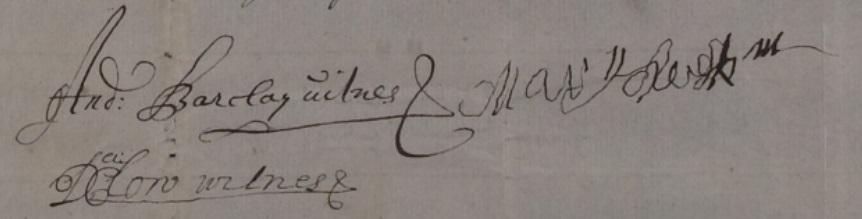
In these final weeks of her life, James Erskine wrote “evry body thought her a dying, & she was disposing on all her gear among the rest” [GD124/15/491]. In a letter to his brother, written in May 1707, he wrote about the various people vying to gain her favour and “knowing she abhors any body who seems to grip at her”. His own machinations were disrupted when he had to leave town and made him “much afraid they would overturn all in my absence”.
Worried that her other associates only wanted her money, he wrote that she “resolved that over & above I should be her sole executor”. One of the men involved “swore that he expected to have managed her himself… but that I had outwitted them”. He admitted “I cannot let it appear that I am expecting any thing from her, and I know you will not mention the story I have written for that would ruin my project”.
It speaks volumes for Mary’s character that despite being in her late 70s and terminally ill, he described her as “pretty fickle & the hardest to manadge”. She undoubtedly stood her ground against conniving gentlemen, instead dividing her funds between relatives and charitable foundations, managing her assets even on her deathbed.
Mary finalised her will in June 1707 and died in July. It is possible to get a glimpse into the breadth and scale of her success through her testament which lists more than fifty people she had outstanding financial dealings with [CC8/8/83/764]. Male or female, high-flying political figures, merchant burgesses or modest widows, large loans or small, all of them appear in her will. She also left her physical possessions, including the shop, her household goods and gear to her friends, associates and servants.
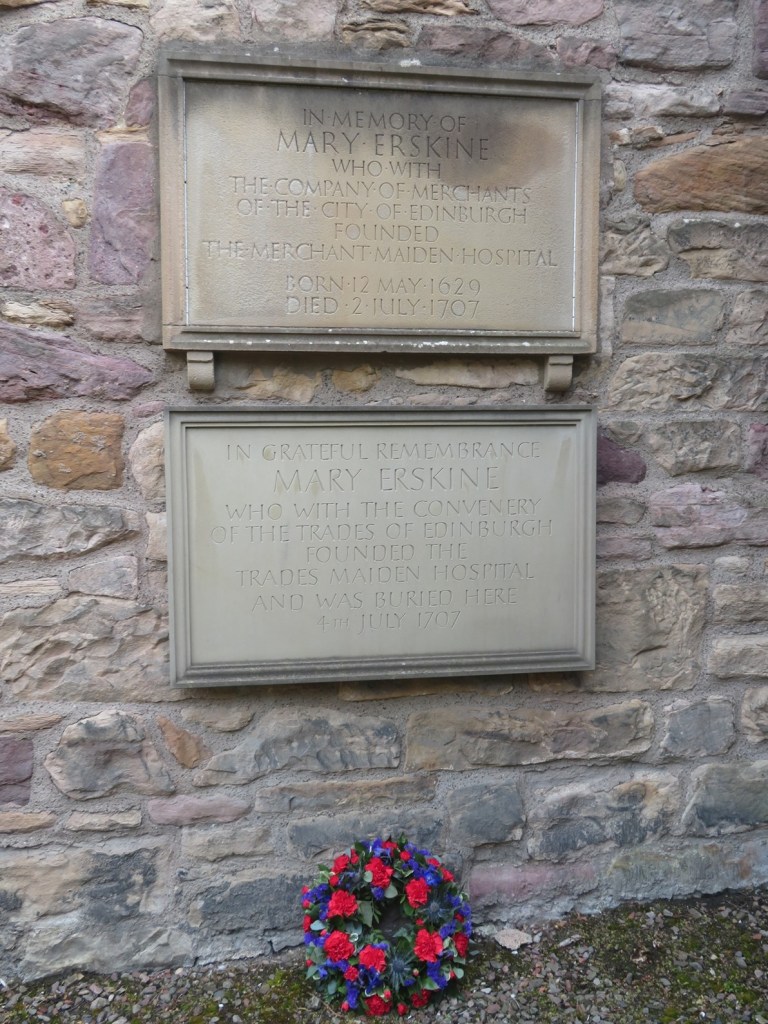
She was interred in Greyfriars churchyard, in the closed-off section now known as the Covenanters’ Prison, with a memorial plaque commemorating her work and the foundation of the school that still bears her name.
Clare Stubbs
Digital Imaging Unit Team Leader

