
Though three men dwell on Flannan Isle
Flannan Isle, Wilfrid Wilson Gibson
To keep the lamp alight,
As we steered under the lee, we caught
No glimmer through the night.
…..
Aye: though we hunted high and low,
And hunted everywhere,
Of the three men’s fate we found no trace,
Of any kind in any place,
But a door ajar, and an untouched meal,
And an overtoppled chair.
The Flannan Isles Lighthouse was operational for a little over a year when the Keepers disappeared. 21 miles west of the Isle of Lewis, the Flannan Isles are sometimes known as the Seven Hunters. The lighthouse is situated on the largest of the island group on the 38-acre Eilean Mor (Big Island). Designed by David Allan Stevenson – son of David Stevenson – it sits on a 200-foot cliff, a 75-foot tall white tower; the beacon has a range of 20 miles and flashes two white signals every 30 seconds.
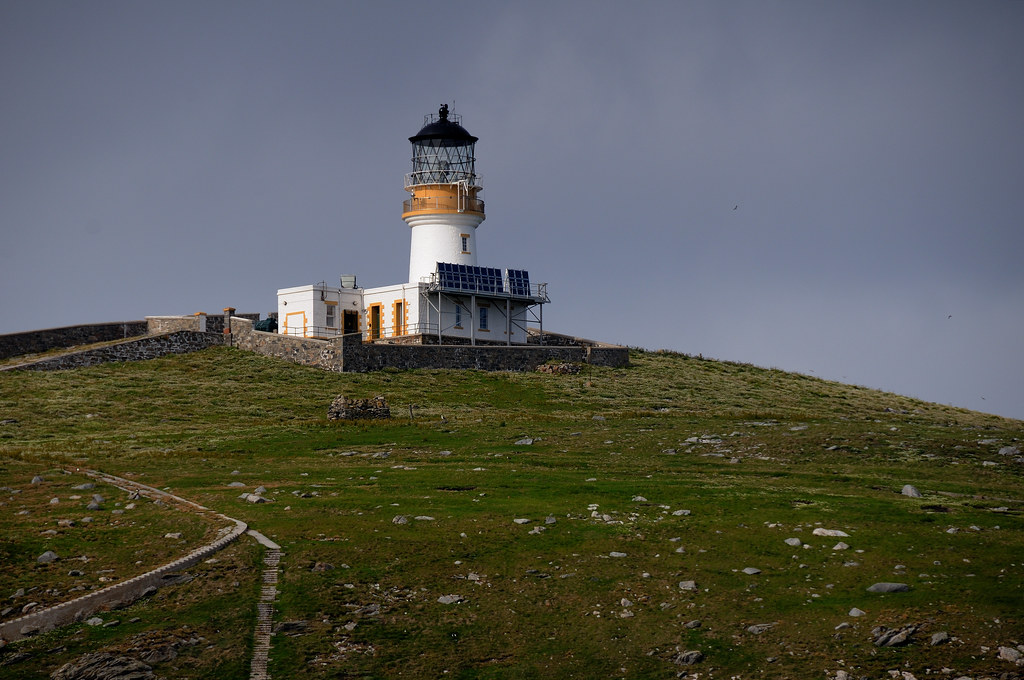
Approval for the construction of a lighthouse on the Flannan Isles was received from the Board of Trade in 1896, but it wasn’t until the 7 December 1899 that work began. Built by George Lawson of Rutherglen between 1896-1899, he constructed the lighthouse as well as the landing places and stairs on the island, and the houses for the lightkeepers’ families at the shore station at Breasclete, on Lewis.
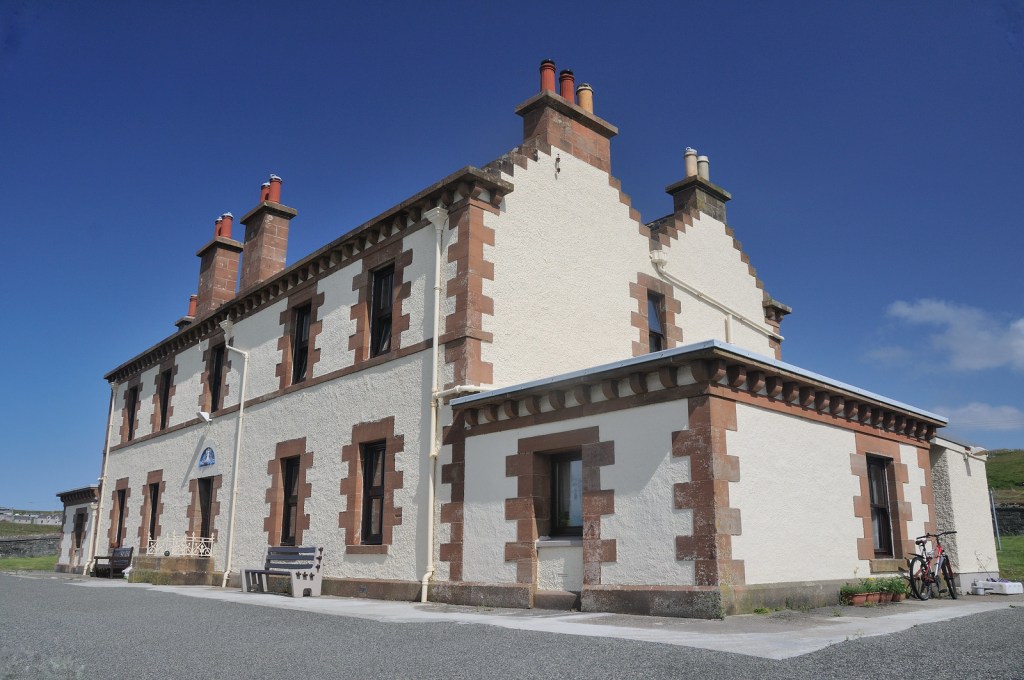
During the Lighthouse’s operation, fortnightly reliefs were carried out until the disaster of December 1900. Prior to the discovery that the men were missing, the light had not been seen on the islands from the nearest point on Lewis, 16 miles away, for 10 days.
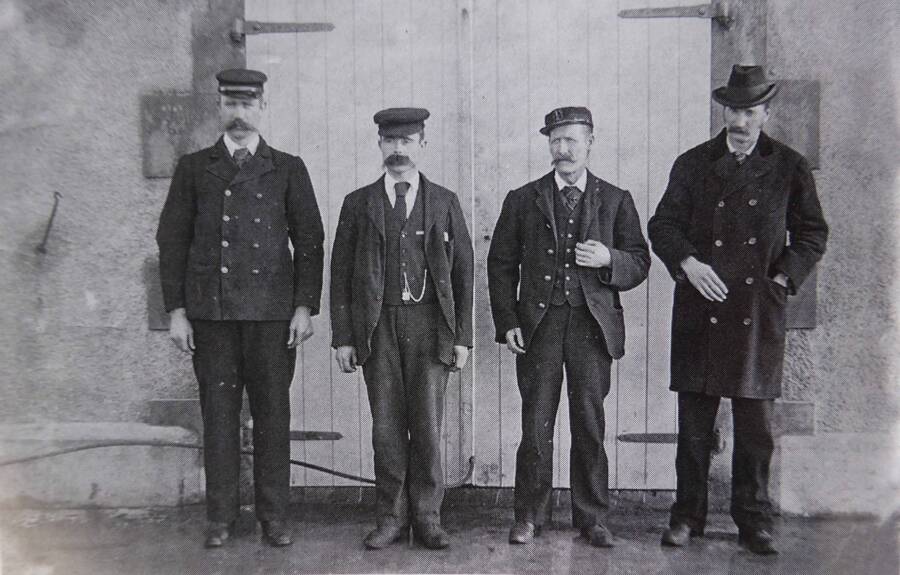
At the time three Lightkeepers were on duty at the lighthouse: James Ducat, Principal Lightkeeper; Thomas Marshall, Assistant Lightkeeper; and Donald McArthur, Occasional Keeper, who was on duty for William Ross (Assistant Lightkeeper) who was absent on sick leave. One other Assistant Lightkeeper, Joseph Moore, was on shore duty on Breasclete.
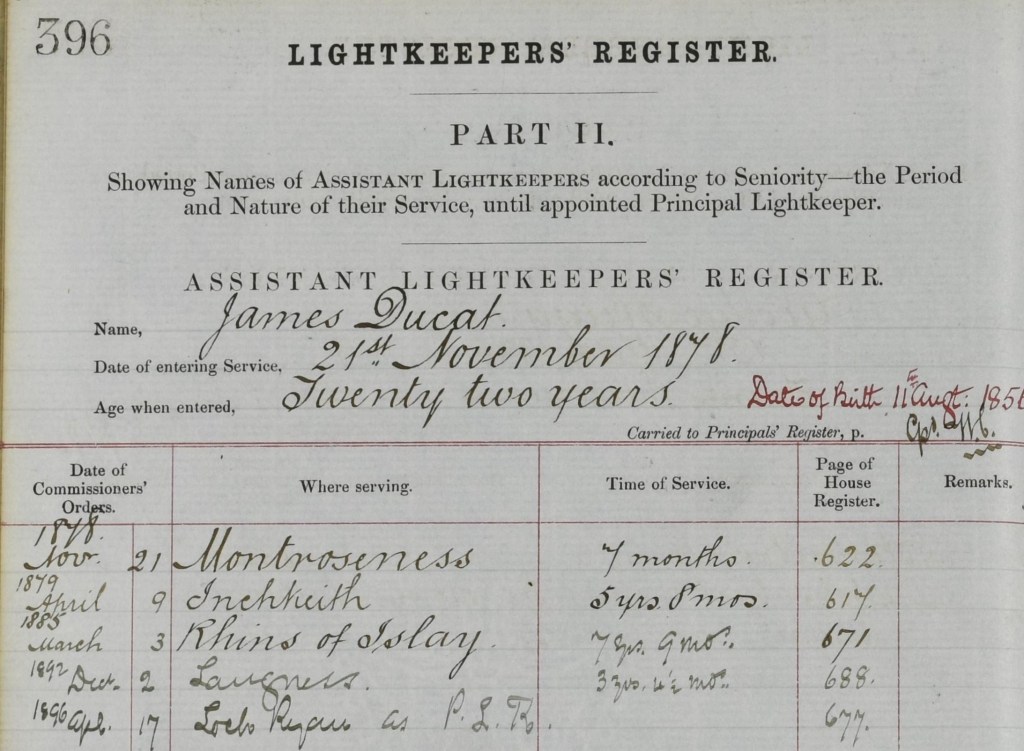
James Ducat was born on 11 August 1856 to James Ducat, Ploughman, and Louisa Ducat, née Guild. He had entered the service of the Commissioners of Northern Lighthouses on 21 November 1878, at 22 years old, and had served in a number of different lighthouses. His longest duration was at Rhinns of Islay Lighthouse for 7 years and 9 months, and by the time he reached the Flannan Isles he had been promoted in April 1896 from Assistant Lightkeeper, to Principal.
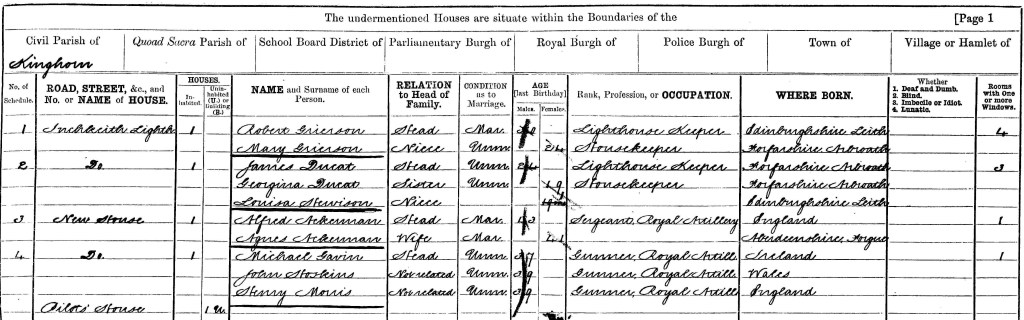
James married Mary Grierson on 9 June 1882 at Hutton Place, Edinburgh. Although James does not appear to be descended from lightkeepers, Mary certainly was with both her father John, and uncle Robert working at different lights. Tracing her through the census records, in 1881, a year before her marriage, she was living with her Uncle Robert Grierson at no. 1 Inchkeith Light, and James Ducat was living at no.2 with his sister and niece. It seems likely that this is where they met and came together, before marrying in 1882.
Thomas Marshall was the Assistant Lightkeeper and had entered the service of the NLC on 27 April 1896 at 27 years old. His entry in the Lightkeepers’ Registers note that he was previously a seaman, and Occasional Lightkeeper when resident on Ailsa Craig. Donald McArthur as an Occasional Keeper, was not recorded in the Registers.
The disappearance
A steamer passing the lighthouse around midnight on the 15 December noted that the light was not lit and reported this when they arrived at port. However, this fact was not communicated to the Commissioners and the disappearance of the keepers was only discovered as a result of the routine visit by the Lighthouse Tender Hesperus, on 26 December 1900.
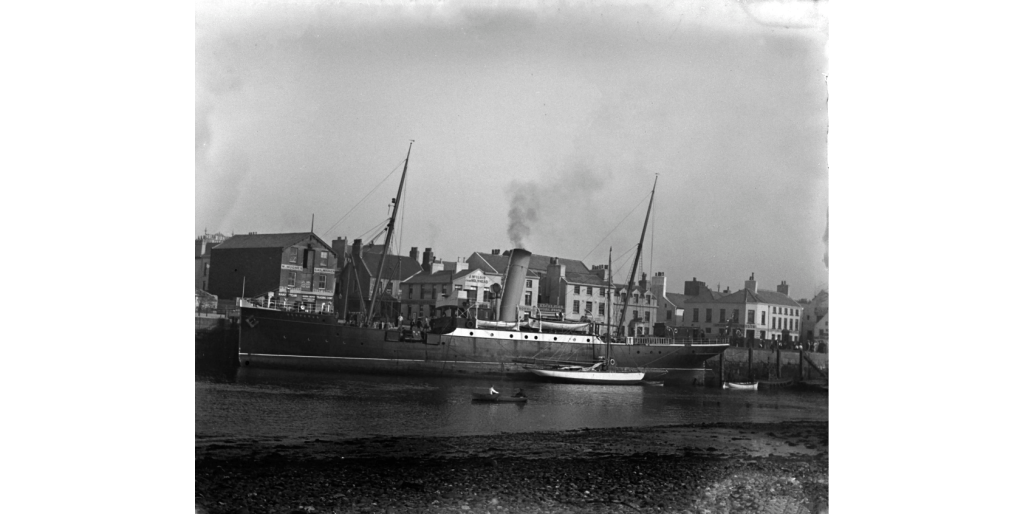
Captain Harvie was in command of the Hesperus. He reported that there was no sign of life to be seen on the Island, and no response was made to either the horn being sounded, or to a rocket fired from the ship. The relieving Keeper, Joseph Moore, was landed to investigate, but upon entering the lighthouse, found no one there. Moore reported these facts to the Master, and was returned to the island with Mr MacDonald, Buoymaster (who was on board the vessel at the time), and Seaman Lamont and Campbell, all three having volunteered to remain on the Island with Moore to ensure the light was kept in operation.
Further investigation ensued, and it was confirmed that Moore had found the station deserted, with lamps trimmed and ready, the lens and machinery cleaned, the kitchen tidied, and two sets of outdoor clothing missing. No trace of the men was discovered.
From the archives in the National Records of Scotland (NRS) we can trace the correspondence detailing the investigation of the men’s disappearance, with letters written to the Commissioners by Joseph Moore, and a report submitted by the Superintendent Robert Muirhead on 8 January 1901. From these, we know that the last entries in the keeper’s log were for the 13 December, but particulars for the 14 December, and the time of extinguishing the light on the 15 December, along with barometer and thermometer readings, and the wind conditions at 9am on the 15, were all noted on a slate for transferring to the log later. Everything was in order, “the lamp was cleaned. The fountain full. Blinds on the windows etc.’, and clear evidence of the work of the forenoon on the 15 having been completed; all of which suggests the men disappeared on the afternoon of Saturday 15 December.
While no evidence of the men was found, traces of bad weather were present. Robert Muirhead’s report notes:
“…The iron railings round the crane platform and from the terminus of the tramway to the concrete steps up from the West landing were displaced and twisted. A large block of stone, weighing upwards of 20 cwt, had been dislodged from its position higher up and carried down to and left on the concrete path….A life buoy fastened to the railings along this path, to be used in case of emergency had disappeared, and I thought at first that it had been removed for the purpose of being used but… it was evident that the force of the sea pouring through the railings had, even at this great height (110 feet above sea level) torn the life buoy off the ropes”
NRS, NLC3/1/1
It was concluded that the men must have left the lighthouse for some purpose in this weather, perhaps to secure some gear or to ascertain what damage had been done. With Moore’s knowledge of the lightkeeper’s working clothes, Muirhead could guess that they had made their way to the landings:
“When the accident occurred, Ducat was wearing sea boots and a waterproof, Marshall sea boots and oilskins, and as Moore assures me that the men only wore those articles when going down to the landings, they must have intended, when they left the Station, either to go down to the landings or the proximity of it”.
NRS, NLC3/1/1
The conclusion of the investigation suggests that the men had been caught by an unexpected ‘large roller’ (wave) and swept into the sea.
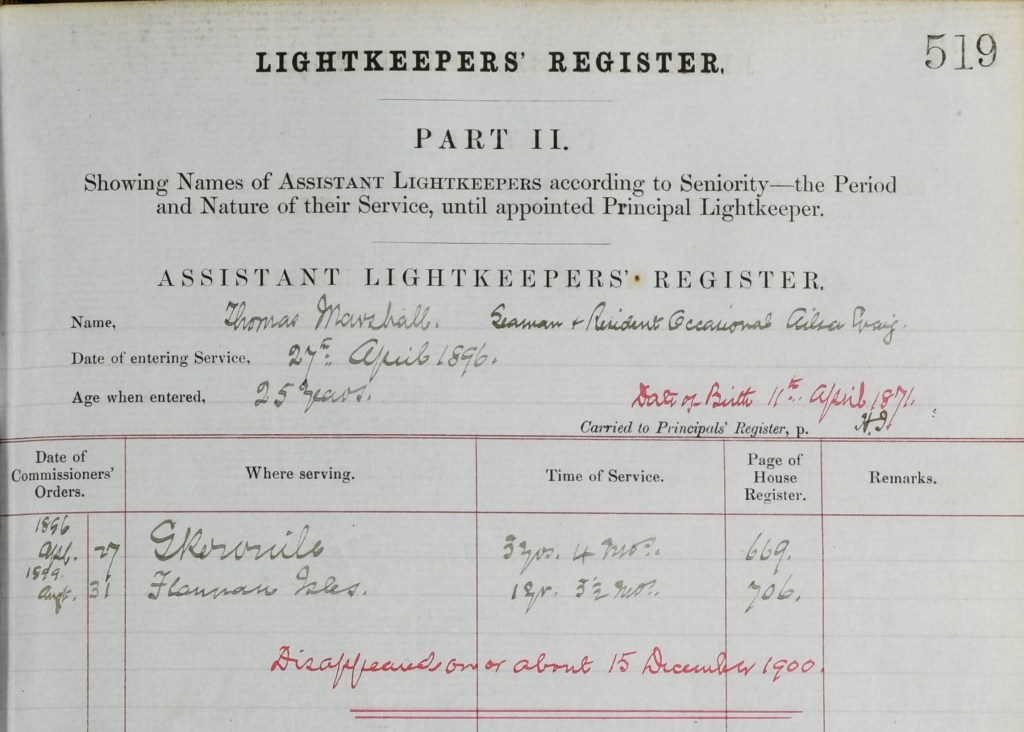
Four volumes from the Lightkeeper Register of the Commissioners of Northern Lighthouse, spanning a total of 84 years (1837-1921) were recently imaged and made available on the National Records of Scotland’s service, ScotlandsPeople. These registers are indexed and can be searched by name, age and the year an individual entered into service. The register entries for Ducat, and Marshall include a note in red ink ‘Disappeared on or about 15 December 1900’, and all three men are recorded in the register of deaths for the district of Carloway, on the same page, with the cause of death noted as ‘probably drowning’.
Keeper James Ducat was survived by his wife and four children, Louisa (16), Robert (13), Annabella (9) and Arthur (6). Thomas Marshall was unmarried and had no children, but was survived by his father, brother and sister. The correspondence records suggest that Donald McArthur was survived by his wife and two children, who are yet to be definitively identified in our records.
There have been many books written about, and inspired by the disappearance of the Flannan Isles lightkeepers, with the film ‘The Vanishing’ released in 2018 based on the story. While it is likely that the mystery behind the keepers disappearance will continue to fascinate, it is worth remembering that three keepers lost their lives in pursuit of their duty, and the families of these men, to this day, do not know for sure what happened.
Jocelyn Grant
Archivist
*This photograph has been published in good faith and for an educational, non-commercial purpose, as a rare example of an image of all the Keepers discussed in this article. While, based on the estimated date of this image, it is out of copyright, we have been unable to locate an owner. If you know, or are the owner of this image, and are concerned about its use here, please contact education@nrscotland.gov.uk.


May these brave and Honourable men Rest in Peace forevermore.
LikeLike
Thank you for taking time to share this well-told and beautifully-documented mystery of the disappearance of loyal keepers of the lighthouse long ago. Your documentation in telling the story shows others how to weave a tale: going off original research and documentation (not relying on the “facts” provided by others) and also shows the beauty of mystery. It is perfect as it is, with no speculation by the writer nor added drama. And a poignant reminder of the ways in which men and women every day silently risk their lives for the safety of others.
LikeLike
And never once were aliens mentioned 🙄
LikeLike
Aliens are mentioned if you dig a little deeper
LikeLike
Umm, that’s because they’re not real, mate.
LikeLike
Thank you -I often think of those men as James Ducat was a relative and Bella Bathgate interviewed my mother in Arbroath when she was writing the book the Lighthouse Stevensons
LikeLike
Sorry to nitpick , but wasn’t it Bella Bathurst who wrote the excellent book about the Stevensons?
LikeLike
Good Morning Isabel, Just seen this item and thought I’d give you a quick reply. My Step-Grandfather was Joseph Moore. He told me the story when I was about 5 years old. The story of the Flannan Isles, has followed me, all my life. I have seen it mentioned on YouTube, Sky Documentary channel and various books. Joseph’s son, James, who was my uncle, kept trying to get as much information about the incident, from the internet, as possible. I searched high and low but what I could find, only showed what was generally known. My uncle asked if I could get any information on the families and whether the wives received a pension etc. I was limited in what I could find. However, with the advent of Ancestry.co.uk, it is interesting to see some of the information as regards the keepers history. Joseph More was my father’s step father. My father, always suggested that I join the Northern Lighthouse Board as a keeper. I never did that but pursued a career at sea and ironically enough, ended up buying Lighthouse property in 1992, when the Lighthouses went automatic and the keepers and their families were no longer needed to stay in their NRB dwellings.
LikeLike
Such brave men to do such dangerous work. God bless them all. The sea though a wonderful friend can be a very defiant enemy. I had a great great grandfather John Campbell (fisherman) who died off the coast of Iona in the Baliphuil Fishing Disaster of 1856. May he rest in peace.
LikeLike
Interesting! History I was not aware!
LikeLike
Intriguing story. I feel so sorry for the families who have never had the opportunity to lay their men to rest and say their final farewell.
LikeLike
Thank you for sharing this story of these brave men.
LikeLike
That is so sad for those poor men to be swept out to sea in such a horrible way. So tragic for their families to never have closure. At least now they are all together in Heaven. But still so sad for the ancestors to never know what really happened.
LikeLike
Blimey! Innit really suspicious how only one coat, boots, and rain slacks are left on the coat holder? And how the supper wasn’t ever touched? And don’t even get me started on the chair… Wow. Such a tragedy, not to know what happened to the poor fellows.
LikeLike
Whats the story on the chair?? I haven’t heard anything about that yet!
LikeLike
The only thing that bothers me, is why it took so long for the three men to be reported missing. As I understand, all of the mean had families. Surely after several days they would have been frantic as to where their men were and reported it. If this subject was included in this short story, I must have missed it.
LikeLike
Hello,
Thank you for your comment. Regarding the lack of contact and the delay in reporting the men missing, I have checked the archives and there appear to have been a number of factors at work.
During this time period the lightkeepers would not have been in regular contact with the shore. Often bad weather could effect deliveries (post) and signals, or delay the relief of the men working. Radio and telephones were not necessarily available, and it was only by 1925 that the Flannan Isles Lighthouse had regular contact with the mainland.
However the records in the archive also suggest failures in communications and mistakes. As noted in the blog post, a steamer did report that the light was not lit on 15 December, but this information was not passed to the relevant authorities. On the shore there was also a watch for Lighthouse signals and light, in this case kept by a Roderick Mackenzie, Gamekeeper, and his sons. The investigative report on the disaster by the superintendent Robert Muirhead includes an examination of the Return Book (record of lighthouse light and signals), the report states:
“From the December Return, I saw that the Tower itself was not seen, even with the assistance of a powerful telescope, between the 7th and the 29th December. The light was, however, seen on 7th December, but was not seen on the 8th, 9th, 10th, and 11th. It was seen on the 12th, but not seen again until the 26th…Mackenzie stated…that the lights sometimes cannot be seen for four of five consecutive nights, but he was beginning to be anxious at not seeing it for such a long period…
Had the lookout been kept by an ordinary Lightkeeper…I believe it would have struck the man shore at an earlier period that something was amiss..” (NRS, NLC3/1/1)
The report goes on to recommend improvements in reporting to avoid such a long duration occurring before anything is reported amiss.
Hope this helps,
Jocelyn
LikeLike
Does this incident/accident have anything to do with the lighthouse incident from Wales in the early 1800s? I’m writing an essay about two films, one of them being The Lighthouse (2019) and I’m trying to gather information about the context of the film (why it was made, why was it made the way it was etc.)
LikeLike
Hi there: I think this is unlikely to have any connection to an earlier incident elsewhere. From the records, it seems like colleagues at the Lighthouse Board presumed the lighthouse keepers were washed into the sea by a wave. Our archivist says in this article that the Flannan incident was an inspiration for the movie “The Vanishing”, which is also about disappeared lightkeepers, and I note the Wikipedia page for the film agrees that it was. I’m afraid I can’t tell you anything about the Lighthouse movie, however! I’ve googled the director’s name and “Flannan” together and it certainly looks like others have made the connection, but I couldn’t confirm that myself. Hope that’s helpful.
LikeLike
what an incredibly mysterious and intriguing story that I ran across while doing some research about rogue waves. Interesting reading on a dark Alaskan evening
LikeLike