
…
In Flanders Fields by John McCrae
“In Flanders fields the poppies blow
Between the crosses, row on row,
That mark our place; and in the sky
The larks, still bravely singing, fly
Scarce heard amid the guns below.”
…
Remembrance Day is a time to commemorate those who gave their lives and served in wars and military conflicts. Established after the end of the First World War, it is a moment of collective grief and memory. Over time, traditions and ceremonies have developed, including the Remembrance march past the cenotaph (a war memorial on Whitehall, London), and local ceremonies at memorials and rolls of honours during which many will wear and present poppies.
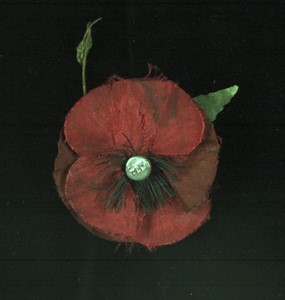
An enduring symbol of Remembrance, the poppy was first used as a marker and as a fund-raising tool in Britain in 1921. The flower was associated with the First World War due to a botanical phenomenon. The weaponry used in the conflict on the Western Front had the effect of creating ideal conditions for the growth of poppies. Bombardments disturbed the soil, bringing seeds to the surface; nitrogen from explosives and lime from shattered buildings helped to fertilize the plants; as did the blood and bones of millions of men and animals. As such, they became a flower commonly seen by soldiers at the time, an unusual burst of colour in an otherwise bleak landscape.
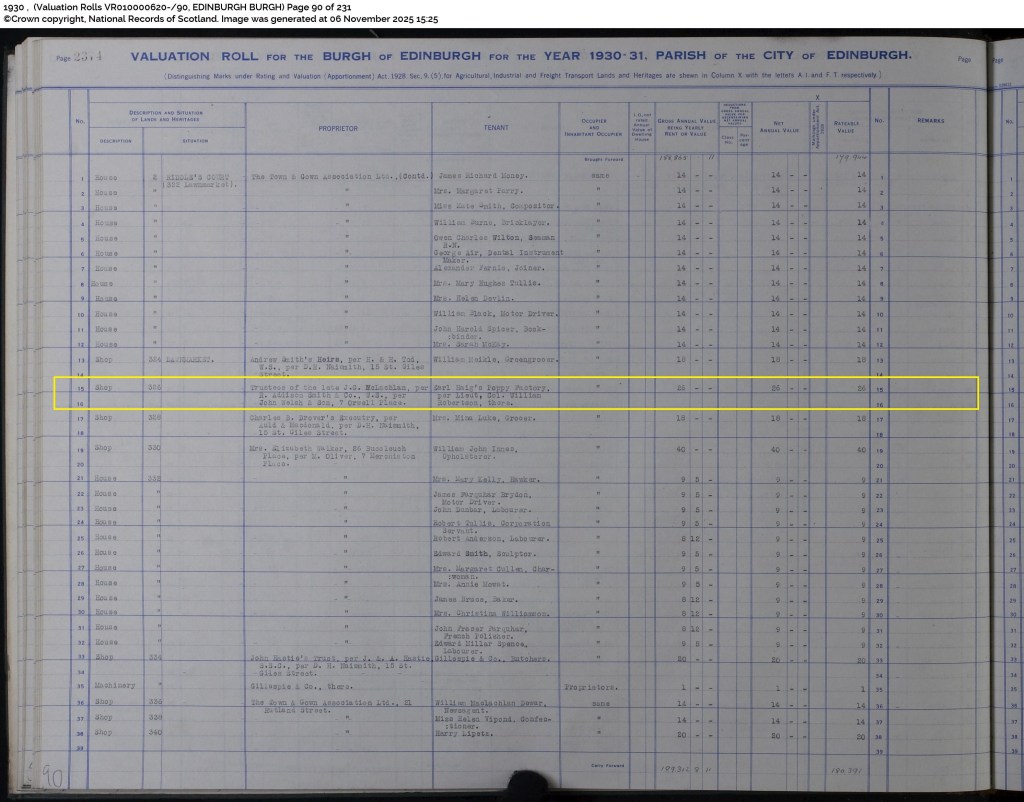
After the war, artificial versions of the flowers were made to sell and generate funds for veteran welfare. After the first ‘Poppy Day’ in Britain, held on 11 November 1921, the venture raised a huge sum, approximately £3 million in today’s money. Such was the success, the British Legion decided to set up its own poppy factory to make artificial poppies. In Scotland, a poppy factory opened in 1926. Proposed by Countess Haig, she suggested that the factory should employ men disabled by the war.

Remembering the World Wars
Over the past year, we have explored the National Records of Scotland’s (NRS) archives to investigate the history of Scotland and its people during, and in the aftermath of, the World Wars. 2025 marked the 80th anniversary of Victory in Europe and Victory in Japan Day.
Victory in Europe Day (VE Day), 80 years on
First celebrated in 1945, the previous six years of conflict had taken a significant toll on the people of the UK. The government recognised the need for an appropriate celebration to mark the end of a war that had cost the country so much. War Cabinet meetings led by the UK’s most senior civil servant, Cabinet Secretary Edward Bridges, discussed and planned how to celebrate an end to fighting in Europe while maintaining essential services. NRS records track how officials prepared, and would be informed of imminent victory by receiving messages codenamed ‘Mousetrap’.
Read our feature to find out more about how VE Day was planned and received: Victory in Europe Day, 80 years on – National Records of Scotland (NRS)
Victory on Japan Day (VJ Day)
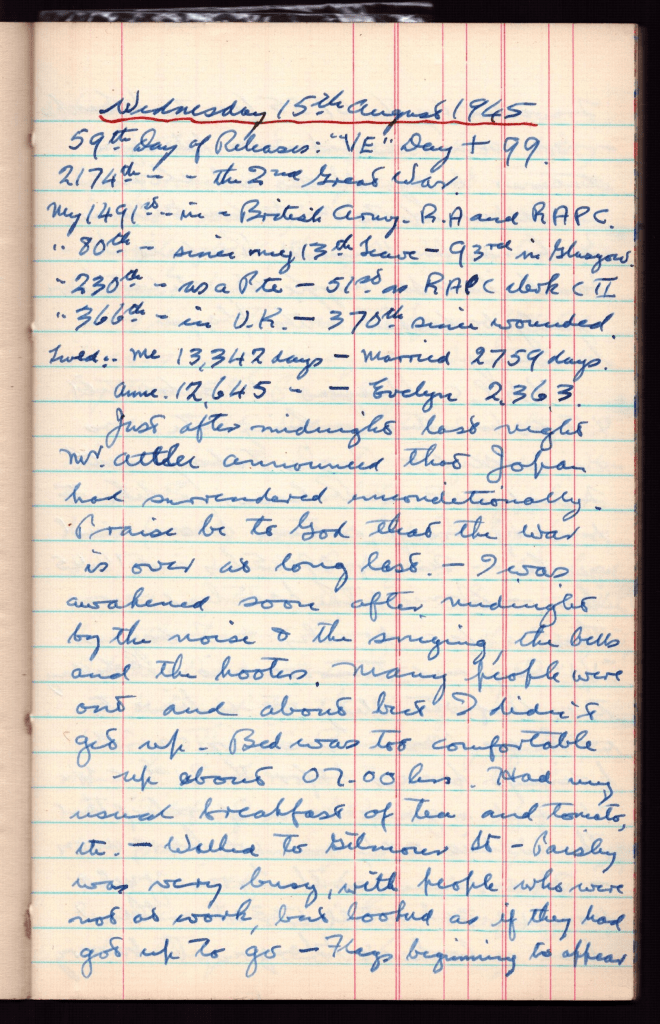
On 15 August 1945, Emperor Hirohito confirmed Japan’s unconditional surrender in a radio broadcast. While NRS holds many official files produced by government departments, we also have many letters, diaries and photographs from individuals. The events of VJ Day were recorded in the diary of Angus McMillan (1909-1993), a Scot who had joined the Royal Artillery and was stationed in Preston during the end of the Second World War. His entry for Wednesday 15 August 1945 begins with “V.E. Day + 99 […] Just after midnight last night Mr Attlee announced that Japan had surrendered unconditionally. Praise be to God that the war is over at long last”.
Find out more about VJ Day in Scotland: Victory on Japan Day – National Records of Scotland (NRS)

Courtesy of Malcolm Ross, Freelance Event Photographer
Alongside our written features, the Outreach and Learning Team and Scotland’s People staff were invited by The Royal Scots Museum to participate in a commemorative event, Gretna 110, which was held from 19-24 May 2025 to mark the 110th anniversary of the Quintinshill Disaster. The Royal Scots curated an exhibition in the former Battalion Drill Hall, now the Out of the Blue community centre in Leith. NRS staff manned a research table alongside The Scottish Genealogy Society, history experts from The Royal Scots, as well as colleagues from the Commonwealth War Graves Commission. We answered a variety of questions from members of the public and helped break down a few family history ‘brick walls’.
We also joined representatives from cultural and heritage organisations across Edinburgh at a military-themed family history fair at Edinburgh Central Library on 24 October. The team spoke to nearly 60 visitors, answering a wide range of enquiries, from how to access our services to questions about Belgian refugees in Edinburgh and the Scottish Women’s Land Army.
Military Records
The NRS archives are a rich resource for those investigating the history of Scotland during the wars, and for those tracing their family tree.
While the majority of official documentation related to the First and Second World Wars is held at The National Archives, Kew, the files of various departments of the Scottish Office are held within NRS. These include:
- HH31: war files, 1914 -1918 covering recruitment and conscientious objectors;
- HH50: war files, 1939 -1945 covering evacuation, emergency powers, civil defence and the Clydebank blitz;
- AF: regulations regarding control of the supply of food appear in the records of the Agriculture and Fisheries Department;
- NSC: files and photographs relating to the War Savings and Tank campaigns of 1918 are preserved in the records of the National Savings Committee;
- HH30: Military Service Appeal Tribunal records 1916-18.
This source list provides some key records held at NRS relating to the military pre, and post-1707:
Scotland’s People
A number of records relevant to searching your family tree are available via the NRS service, Scotland’s People. These include:
The wills of soldiers and airmen
The last wishes of 26,000 Scottish soldiers. Most were killed in action, died from their wounds or went missing on the Western Front or at Gallipoli, Salonika or in Mesopotamia. In addition to the wills from the First World War, there are about 4,750 wills of Scots soldiers serving in all theatres during the Second World War. This includes some women auxiliaries, and several hundred from the South African War and Korean War, and other conflicts between 1857 and 1965.
Military Service Appeals Tribunal Records
From 1916, men seeking exemption from military service could apply to local tribunals, appeal tribunals and a central tribunal based in London. These records allow you to find out about an appellant, his home, family or job; whether they appealed themselves or if others appealed on their behalf; the grounds of the appeal; and whether it was successful or not.
Scottish Women’s Land Army and Women’s Timber Core
Index cards for the service record files for those who joined the SWLA and the WTC from 1939 to 1950 are available to view on Scotland’s People.
Resources used/further reading
- First World War – a series of online features covering different aspects of WWI
- The History of the Remembrance Poppy | Imperial War Museums
- Why We Wear Poppies On Remembrance Day | Imperial War Museums
- Remembrance In The First World War: KS3 | IWM Learning
- National Records of Scotland – Remembrance and the Roll of Honour – Open Book
- Factory history | Lady Haig’s Poppy Factory
- Why the Poppies of Flanders Fields Became a Symbol of Remembrance
 Open Book