
National Records of Scotland (NRS) is taking part in Doors Open Days (DOD) again this year, on Saturday 27th September. The aim of DOD is to give everyone the opportunity to explore some of the most architecturally and culturally significant buildings in Scotland, places which are not usually open to the public or which usually charge an entry fee. The Scottish Civic Trust coordinates DOD across Scotland.
NRS is delighted to take part by opening our doors at General Register House (GRH). It is one of the oldest purpose-built archive buildings still in use in the world and holds Scotland’s national archives.As part of DOD 2025 visitors to GRH can:
- Take behind-the-scenes tours of the building.
- Drop-in for free family history taster sessions in our Scotland’s People Centre.
- View the exhibition “Scots on the Move: Railways and Tourism in Victorian Scotland“.
- View Robert Adam’s magnificent Adam Dome
- Speak to archivists and other specialists to answer questions about their role and the role of NRS.
Please note, the tours advertised on Eventbrite have sold out but a limited number of walk-in places will be available on each tour on the day.
Except for tours, all other activities are drop-in or sign-up on the day, including the free taster sessions introducing Scotland’s People.
Windows to the Past, Doors to the Future
The theme for this year’s DOD is Architectural Heritage: Windows to the Past, Doors to the Future. It aims to promote and inform people about the variety of styles of buildings, whether modern or historical, large or small. Edinburgh has a diverse selection of all, from the tenements in the old town on the Royal Mile, Georgian houses in the New Town or modern day offices and shopping centres.
GRH stands proudly at the east end of Princes Street, in Edinburgh’s New Town.It is a striking example of Georgian architecture in the city. Despite the building’s prominence, many people pass it without knowing what lies behind its doors, or the services provided inside.
NRS exists to preserve and protect Scotland’s national archives for current and future generations. In GRH, we provide access to our records: either in the Historical or Digital Search Rooms, or to digital images of vital life events and other records in the Scotland’s People Centre.
Stepping back to the early 18th century, archival storage and access to recorded history were very different from today. Scotland’s records had been held in various unsuitable locations and suffered from damage caused by damp and rodents. Our records show that while they were stored at the Exchequer court, clerk, Robert Morrison, ‘bred up a cat’ to control the vermin.
In the Laigh Parliament Hall, where most legal records were stored, record officials had to pile up the latest transmissions on the floor. Clerks working in rooms in the High Street could hear family quarrels in neighbouring tenements. It became apparent that these records, at risk from accidental damage and neglect, had to be protected.
The answer was to find a central repository in the city.
One suggestion had been to house the records in rooms in The Royal Exchange (later the City Chambers), designed by Robert and John Adam in 1753 as part of the civic improvements in Edinburgh. Ultimately, it was decided that a purpose-built repository was more appropriate. Acknowledgement for a scheme to raise money for the building goes to the Earl of Morton, Clerk Register from 1760 to 1768, whose personal inspection of the appalling storage conditions in the Laigh Parliament House and elsewhere brought the matter to a head.
In 1765, Morton obtained a royal warrant appropriating £12,000 from the forfeited Jacobite estates – just under £1,230,000 in today’s money. It was to be spent on purchasing ground and building a repository, and appointing trustees to administer the fund. Morton also conceived a design for a repository, which was engraved in 1767. Following the Earl’s death, his successor, Lord Frederick Campbell, a son of the 4th Duke of Argyll and a friend of Robert and James Adam, pushed the commission for the design of the building in the Adam’s direction.
In 1769, the Trustees chose a site at the end of the North Bridge, then under construction, and accepted the architectural plans in 1772. The foundation stone of GRH (or Register Office, as it was originally known) was laid on Monday 27 June 1774 by Lord Frederick Campbell, Lord Clerk Register, Sir James Montgomery, His Majesty’s Advocate for Scotland, and Sir Thomas Miller, Lord Justice Clerk.
GRH, in its early days, must have looked larger than life alongside the plain-fronted houses of east Princes Street, dwarfing the Theatre Royal opposite. It gave Robert Adam the opportunity to establish himself in Scotland as a designer of public buildings. It was a striking addition to the developing New Town, becoming the focal point of a vista looking from the Old Town. Internally, the 80 feet (24 metres) high central Dome of Register House with its fine plasterwork ceiling, rising from the rectangular arrangement of working offices, was designed to evoke the atmosphere of a great public building of classical times, being modelled on the Pantheon in Rome.
Relatively few of Robert Adam’s architectural drawings for Register House now survive, either in the National Records of Scotland or in Sir John Soane’s Museum in London. However, the construction of Register House is better documented, as an unusually large number of full-scale working drawings provided by Adam’s London and Edinburgh offices to craftsmen working on site have been preserved.
Construction drawings, prepared by Adam on 14 October 1772, depict the ground floor plan; sections of the building; elevation (in outline) of the North front; and a plan of the cellars. Further plans and working drawings were prepared between 1774 and 1776 relative to details of the front columns, windows and entablatures, with various mouldings and cornices.
During the year 1785, when building work resumed after six years of inactivity due to a lack of funds, sketches were made for the completion of the Dome as well as for details of the front wall or parapet, balustrade, and design of the lamps. In 1786-88 designs were provided of the chimneypiece and doorway for the Lord Clerk Register’s room; and also for the Deputy Register’s house in 1789.
Beneath this article, we feature a number of the surviving plans depicting some of these features.
We hope you can join us on DOD and explore GRH and the Adam Dome for yourself, but if not, then we invite you to travel back in time with our digital 3D fly-through animation of GRH on our YouTube channel and see the Dome as it is now, and as it was in the 18th century.
Veronica Schreuder
Outreach and Learning Archivist
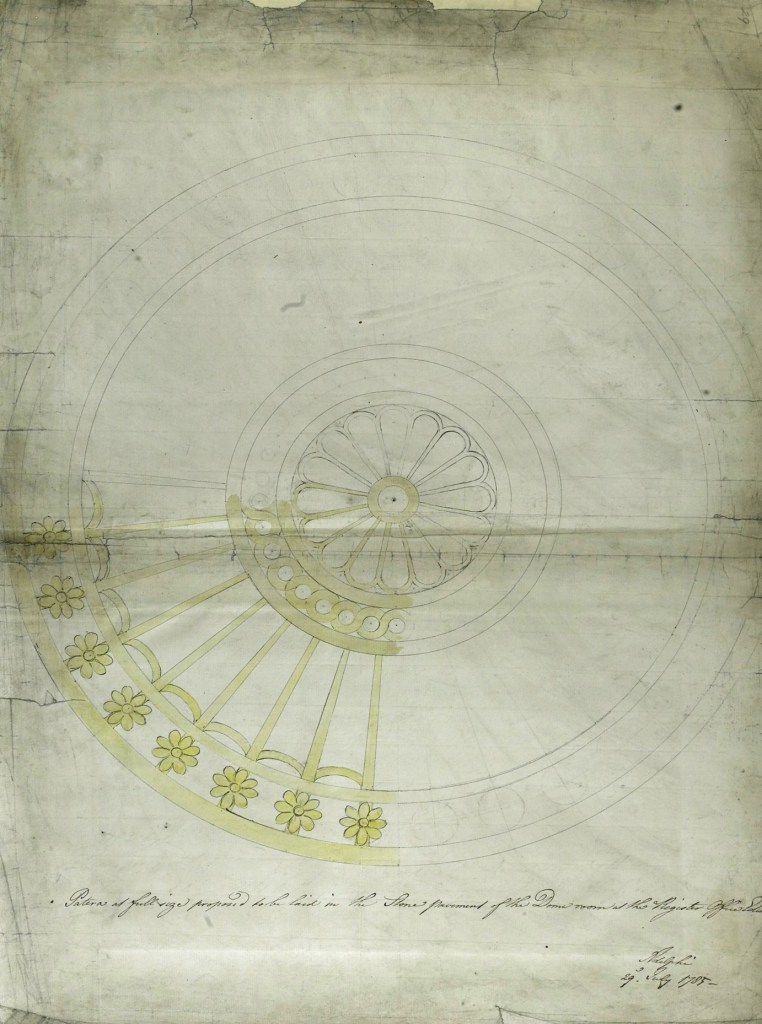
Proposed detail of the interior of the Adam Dome. The writing along the edge of the page reads ‘Patera at full size proposed to be laid in the Stone pavement of the Dome room in the Register Office [as General Register House was named at the time], Edinburgh.’ Dated 29 July 1785. Crown copyright, NRS, RHP6081/29

‘A Design for the Pavement of the Dome room in the Register Office at Edinburgh.’ Notes: ‘The small black squares are proposed to be marble. The Patteras coloured yellow are to give light to the passages below and may be either cast iron or brass. The parts shaded red are … piers proposed to be built which will support the Gallery above & presses for papers to be made between.’ Today the floor of the Adam Dome is covered by carpet. Crown copyright, NRS, RHP6081/30
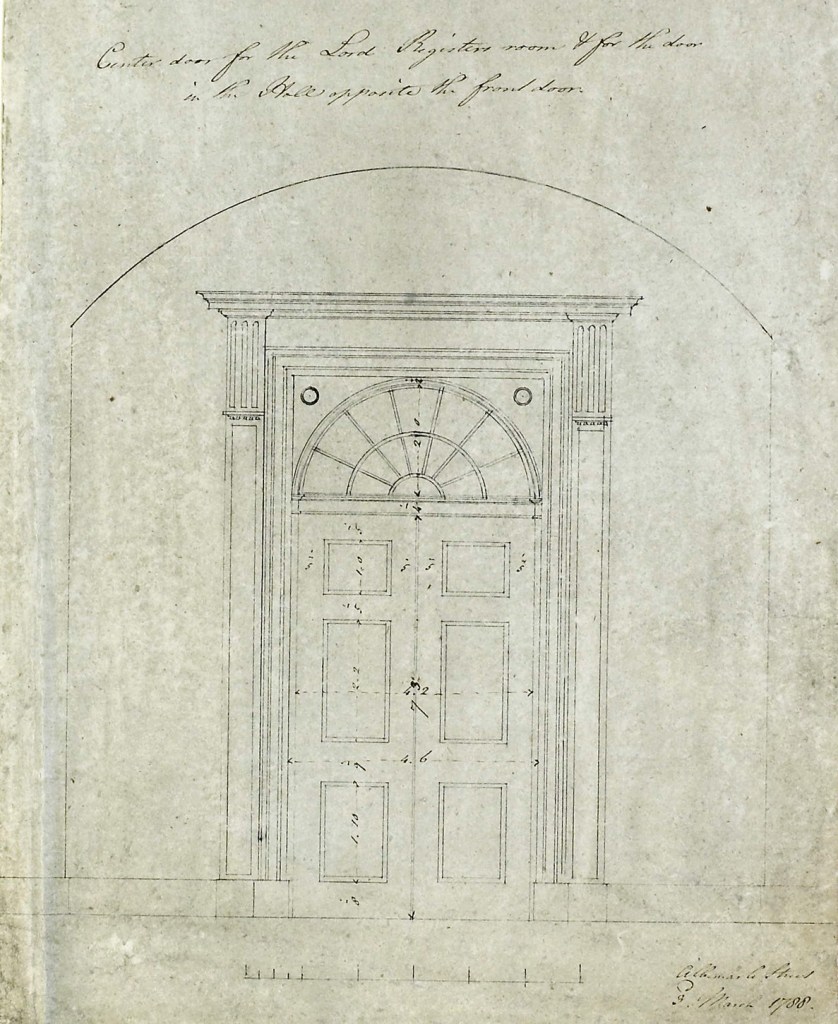
‘Centre door for the Lord Registers room & for the door in the Hall opposite the front door.’ Adam Drawing Office, Albemarle Street, London. 3rd March 1788. Crown copyright, NRS, RHP6081/42
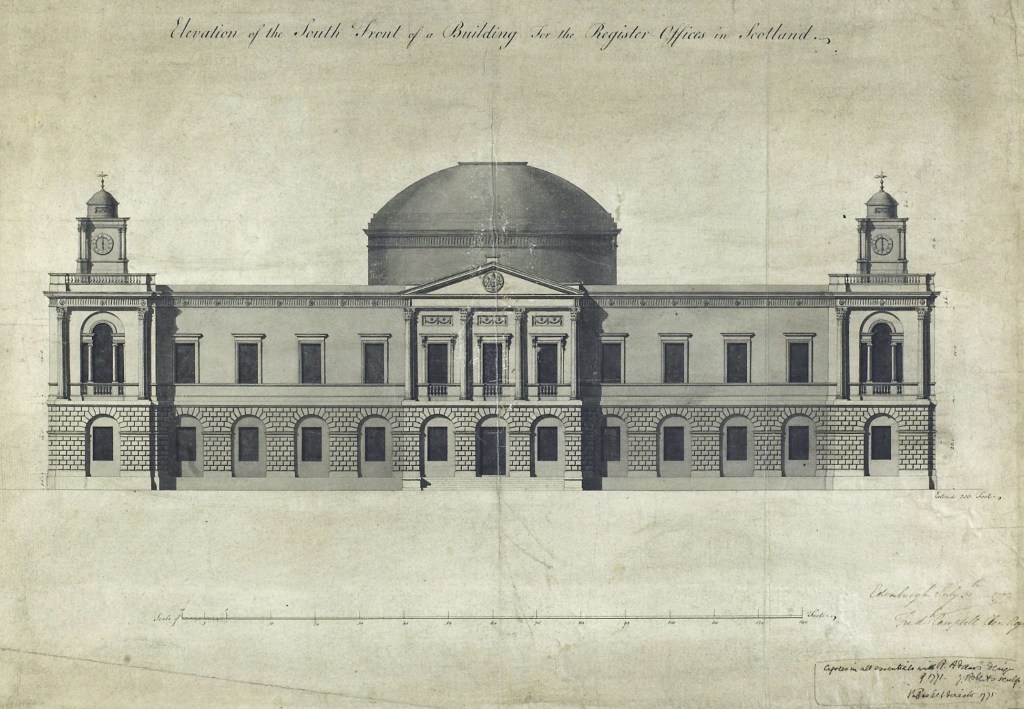
South elevation of Register Offices. Signed: ‘Fred[erick] Campbell, Lord Clerk Register, July 30th 1772’. Note: ‘Agrees in all essentials with R[obert] Adam’s design of 1771. J Roberts sculp. Pub as Act directs 1775.’ Contract drawing signed by the Lord Clerk Register on behalf of the Register House Trustees. Crown copyright. NRS, RHP6082/7

‘Section through the Center Line of the Register Office from North to South.’ (Plate VII). By Robert Adam, architect, 1771. T Miller, engraver. January 1775. Crown copyright, NRS, RHP6082/36

The interior of the Dome as it looks today. Crown copyright, NRS.
Sources/further reading:
Margaret H.B. Sanderson, ‘A proper Repository’ The Building of the General Register House (Scottish Record Office, 1992)
Margaret H.B. Sanderson, ‘Robert Adam and Scotland’, Portrait of an Architect (Scottish Record Office, 1992)
 Open Book