

Some of the most treasured records in National Records of Scotland collections are centuries old. They require meticulous care to ensure they’re preserved for future generations, and never more so than when they are publicly displayed.
The Declaration of Arbroath is over seven centuries old. Conservator Hazel de Vere tells us about the challenges of preparing such a famous document for display at the National Museum of Scotland.
The Conservation department has many roles and duties within National Records of Scotland, the institution responsible for archives that have national importance.
One of these tasks is the care of the Declaration of Arbroath. The Declaration is a letter written to Pope John XXII on 6 April 1320 and sent in the name of 39 earls and barons of Scotland and in the name of the rest of the nobility of Scotland, referred to collectively as “the community of the realm”.
The letter sought to demonstrate to the Pope that King Robert I – Robert the Bruce – should be recognised as the legitimate king of a sovereign kingdom of Scotland. At the time, neither the Pope nor the English king Edward II, recognised Robert, while Edward believed the Scottish Crown should be subservient to the English throne.
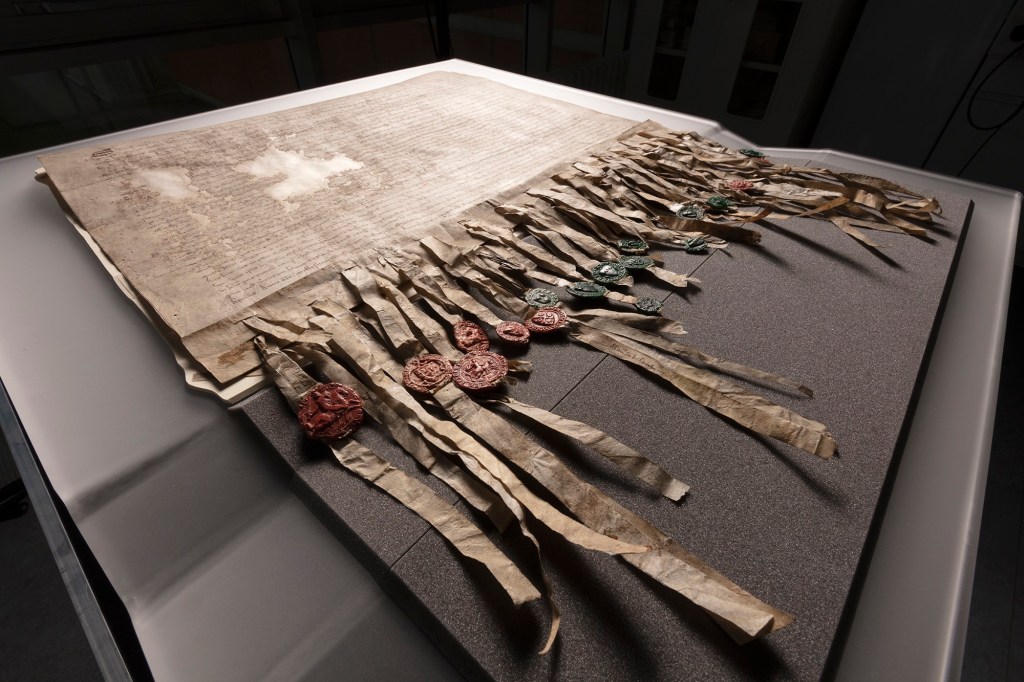
2020 marked the 700th anniversary of the Declaration, and a programme was devised to mark it, including the display of the original document within the National Museums of Scotland, Edinburgh. Unfortunately, this was cancelled due to the Covid pandemic, but in 2023, we went ahead with a four-week exhibition.
Displaying such an ancient document requires much conservation preparation and the involvement of most of our team to complete the many necessary processes.
We carried out detailed photography to ensure that there was an up-to-date surrogate, showing all the information now available. This revealed distinct red flecks of wax within most of the green seals, possibly indicating that the red seals may have been sealed first.

Much of the modern conservation work was done in 2005 before the previous exhibition at the Scottish Parliament, but some consolidation was required before display this time too. All treatments used were as minimal as possible. The tags are fragile and repairs were made using re-moistenable tissue with Isinglass adhesive.
Detailed condition reporting recorded areas with damage, listing all tags and seals. Conservation staff were directly involved in helping with media events, including filming the condition report with the BBC.
Due to the fragility of the document, a great deal of our concerns lay in the actual transporting of the object to the museum: how would it travel, how could we reduce vibration, who would take it, which route should we use, including even a walkthrough of the lifts and any floor issues within the museum.
Our exhibition registrar Saho Arakawa and Head of Conservation, Linda Ramsay, were kept very busy with paperwork relating to the document’s exhibiting and the case move. The case moved the day before the document, to enable it to be fully installed and conditioned inside. Eva Martinez Moya prepared the Prosorb cassettes and a silica gel, used specifically to help stabilise relative humidity inside the display case, between 45–55%.
The Declaration could travel on its custom mount but it required a new box for transit. Conservator Peter Dickson demonstrated his skills by making a box just for this purpose with a plastazote insert designed to hold the mount in place. After some problem solving, the introduction of magnets and even the use of a heat gun, the box was ready.

The box itself then went into a transit crate which was also made for the purpose. It fitted like a glove and we practised many times (without the document!) to ensure that the box was lowered perfectly level into the crate. The crate was then moved by art handlers and off it went, accompanied to the museum.
The crate was moved directly through the museum while it was closed to the public, to the secured exhibition space.
Next was the unpacking and condition checking with the museum. The document was assessed with the museum’s conservator, going over each tag, seal and textual area. Once completed and signed off, we were ready to install.
Even though the case was cleaned before departure, further detailed cleaning of the interior was required to prevent any hairs or fluff from being trapped. Then we were ready to place the document inside, with a monitor to record conditions within the case and an alarm.
After this, a lighting check was performed to ensure that light levels were within the agreed limits. The lighting designer cleverly devised the light to gradually reduce from 50 to 40 to 30 lux in the exhibition so that the human eye had adjusted by the time they got to the case which was at 20 lux. This helps prevent damage and fading to the ink and ensures the Declaration is preserved for the future.

Finally, after more media events, all was ready for the grand opening. And then, after 31,000 visitors, four-weeks later, we did most of this in reverse to safely return the document to National Records of Scotland.
Hazel de Vere
Book and paper conservator
National Records of Scotland
A version of this article originally appeared in the Scottish Council on Archives: Year in Review 2023-24. All images are Crown copyright, National Records of Scotland.
 Open Book