
The Games of the XXXIII Olympiad in Paris is within touching distance and as Olympic fever mounts, we look back at Scottish athletes who have broken records in previous Games.
In Paris 1924, it was Scottish sprinter Eric Liddell (16 January 1902 – 21 February 1945) who stole the headlines, breaking the Olympic and world records in the 400 metres, despite his specialist event being the 100-metre sprint. Liddell was considered the fastest runner in Scotland over 100 metres, but the scheduling of the heats on a Sunday, led to Liddell, a devout Christian, withdrawing from the competition. Liddell switched his attention to the 400-metre event, whose heats were held on a weekday. The story of his life and his success at the 1924 Olympics served as the inspiration for the Oscar-winning film, ‘Chariots of Fire’.
Eric Liddell was born in 1902 in Tientsin, China. Liddell’s father, Reverend James Dunlop Liddell, originally from Greenock, had settled in China and worked as missionary.

The family are enumerated in the 1921 Scottish census living at 4 Merchiston Place, in the Morningside area of Edinburgh, having returned to Scotland from China when Liddell was six years old. At the time of the 1921 census, Liddell was enrolled as a student at the University of Edinburgh and was noted as ‘Science student’.
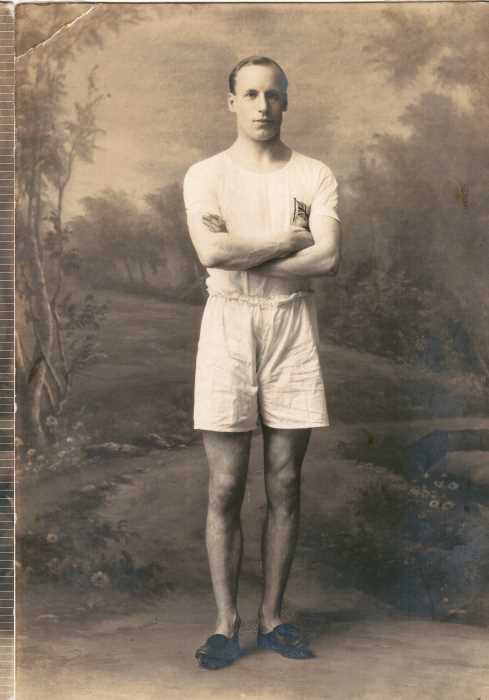
Image credit: Courtesy of the Eric Liddell family and the Eric Liddell Community
As well as being an outstanding sprinter during his student years, Eric Liddell represented Scotland seven times at Rugby, playing in the Five Nations series in both 1922 and 1923. The same summer as his Olympic feats, Liddell graduated from the University of Edinburgh. Turning down the possibility of a glittering sporting career, Liddell returned to China to undertake missionary work, later being ordained as a Minister of the Congregational Union of Scotland. Liddell spent the rest of his life in China, where he died in 1945, aged 43.
In comparison to Liddell, there is the lesser-known, but no less significant, Olympic medal winning performance of Isabella Moore. Moore was one of the first women to represent Great Britain in an Olympic swimming event and ahead of the 2024 Paris Games, still holds the record of being the youngest British Olympian to win a gold medal at the age of 17 years and 266 days.
Born 23 October 1894 in Govan, Moore was the daughter of Duncan Moore, iron turner and Mary Cleland (née Moore).

(NRS, crown copyright, 646/1 743 page 248)
In 1911, a seventeen-year-old Moore, known as ‘Belle’, was living at home on Mclean Street in Govan, along with her five siblings.

(NRS, crown copyright, 646/117/9 page 9)
In the early years of the twentieth century, swimming lessons were increasingly being offered as part of the school curriculum in Glasgow. Through these lessons, Moore became an extremely good swimmer and soon became a swimming instructor in Govan. She continued to swim competitively, representing the Glasgow-based Premier Club, and winning the Scottish women’s swimming championship while still a teenager.
As a result of her strong domestic performances, Moore was selected as part of a 4 woman team to represent Great Britain at the 1912 Summer Olympics held in Stockholm. The 1912 games were the first time that women’s swimming had featured as a competitive event. However female competitors were restricted to two events, the 100 metres individual freestyle and a 4 x 100 metres relay. Moore participated in both, but her performance in the 100-metre freestyle was not encouraging and she was eliminated in the early rounds.
A few days later on 15 July 1912 the team event took place. Moore swam the first leg and put her team ahead of the German, Austrian and Swedish athletes. Moore’s teammates, Annie Speers, Irene Steer and Jennie Fletcher extended their lead and Great Britain’s first ever women’s Olympic swimming team ‘won comfortably by 12 yards’ (Aberdeen Press and Journal, 16 July 1912), with a winning time of 5 minutes and 52 seconds. Moore and the rest of the British team received their gold medals from King Gustav V of Sweden.

Moore’s Olympic experience spurred her on in domestic competition and on returning to Scotland she set a new 200 metre freestyle record which stood for several years. She also continued to teach swimming and on her marriage certificate of 1919, her occupation is given as ‘Swimming Instructor’.

NRS, crown copyright, 644/18 page 15
After her marriage, Moore emigrated to the United States and settled in Maryland. She continued her involvement in swimming until her later years. Isabella ‘Belle’ Moore or Cameron died aged 80, in 1975.
Jessica Evershed
Outreach and Learning Archivist
 Open Book
This blog was thorough and well-structured, thank you! Veronica Dantas
LikeLike
This blog was thorough and well-structured, thank you! Veronica Dantas
LikeLike