
World Chocolate Day is celebrated annually on 7 July as it is thought that chocolate was introduced to Europeans on this date in 1550. It was first enjoyed on the continent as a beverage in the coffee houses of the 17th century and thought to have health benefits, even prolonging the lives of those who drank it. As our desire for this sweet treat grew, chocolate was later incorporated into desserts and confectionery.
One German native, Charles Schulze, saw an opportunity to introduce luxury chocolate confectionery to Scotland and built a chocolate factory in the seaside suburb of Portobello, Edinburgh. In this commemorative feature, we learn about Charles’s endeavours, and the opposition he faced from authorities and his fellow citizens, by consulting the collections of the National Records of Scotland (NRS).
Charles Schulze was born in Brunswick, Germany, to Carl Schulze, merchant, and his wife Johanna Waber around the year 1840. As a young man, he served an apprenticeship in the cotton trade in his home town before moving to Hamburg in 1860, where he worked for A. G. Gow – a firm which exported jute and linen from Scotland to Germany. Charles left Germany for the Scottish Borders town of Galashiels and set up a partnership with his employers. In 1873, Charles secured premises in Ladhope Vale and traded under the name ‘Schulze, Gow & Co.’ This partnership was dissolved in 1875 and Charles continued to trade independently, establishing a successful business in the process.
By 1876, Charles had established even stronger roots in Scotland when, on 14 November, he married Mary Paterson Lees, the daughter of Hugh Lees, writer [to the Signet] and banker, and his wife Helen Maxwell, in Galashiels. It was in Galashiels that Charles and Mary would settle and raise their family.
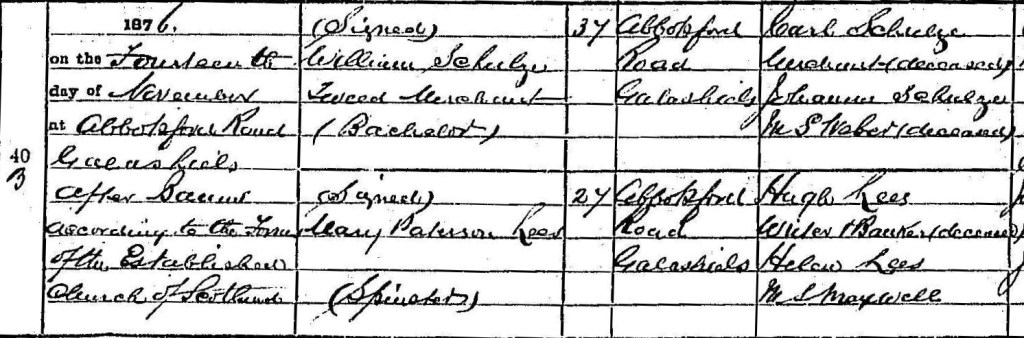
Crown copyright, National Records of Scotland, Statutory Register of Marriages, 1876, 775/40 page 20.
Evidently, Charles continued to prosper in the linen and jute trade; the 1881 census records Charles, Mary and their children living in some style at ‘Boleside’, a substantial house with at least 22 rooms. Charles, a woollen cloth merchant, was enumerated with his wife and their two sons, Charles and Rudolph. Another son, Hugh, and two daughters, Mary and Alevine, were also born over the next 10 years.
By the 1891 census, the family were living in an eight-bedroom home called ‘Brunswickhill’, named after Charles’ place of birth and built especially for the Schulze family.
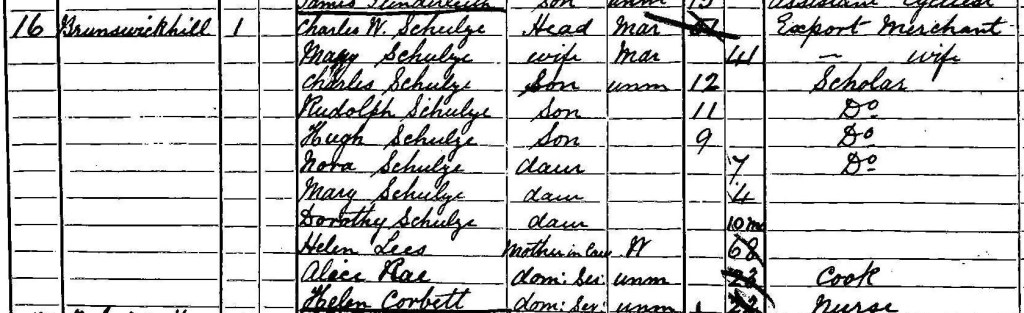
Crown copyright, National Records of Scotland, 1891 census, 775/15 page 4
Situated just south of Galashiels, Brunswickhill was designed by the architect Andrew Heiton (Junior). Today it is a B listed property in Scotland and is a fine example of a classical Italianate suburban architecture.
In 1906, Charles began a business quite separate from textile manufacturing and export; the production of Belgian and German chocolates. On 20 April 1905, Charles was granted a feu by feu charter (the most common form of land tenure in Scotland) for an area of ground measuring one and a half acres on the Craigentinny Estate (NRS, GD283/6/310). This was recorded in the Register of Sasines on 19 April 1906 with an annual feu-duty of £82 10s. The chocolates created in his new factory in Portobello, a seaside town on the outskirts of Edinburgh, would have been something of a novelty in early-twentieth century Scotland, being among the first continental chocolates on sale.
Charles intended his new factory to be an eye-catching and substantial four-story building, measuring nearly 50 metres in length. It was constructed in red brick with concrete cornices and balustrades and was equipped with its own power plant. The construction required concrete foundations and iron pillars with thick floors and walls to support the weight of the equipment needed to manufacture the confectionary. As such, the new factory was one of the first industrial buildings in Scotland to use reinforced concrete in its construction. This elaborate new building was fully designed, erected and equipped at Charles’s personal expense between the years 1906-1908, at a cost of £21,824, equivalent to a cost of £1.7m in 2023, according to The National Archives’ currency convertor.

Crown copyright, National Records of Scotland.
By 1908, Charles was 70 years old and delegated the day to day running of the site to his three sons, Charles, Rudolph and Hugh. Chocolate production began in 1911 but was halted by the outbreak of the First World War in 1914. The onset of war saw a rise in anti-German prejudice. A businessman manufacturing German-style chocolate and possessing a German name was not viewed favourably by the Scottish public. Charles and his sons were soon subject to outlandish rumours that their chocolate factory was a haven for anti-British activity and spying. Keen to dismiss these baseless rumours and to emphasise the quality of their product, the Schulze family were quoted in the Edinburgh Evening News on 7 November 1914 as saying ‘The factory was built to capture the foreign high grade chocolate trade, and oust the German and French firms from the market.’
The onset of war also brought trouble for German-born Charles. Although he had lived in Scotland for 40 years and married a Scottish wife, Charles had not applied to become a British citizen. With the country at war, he could no longer apply for citizenship and was legally viewed as an ‘enemy alien’ and had to register as such with the local authorities. Despite this, all three of his sons signed up to fight against the German forces with the British Army. The Portobello factory he had worked so hard to create was requisitioned by the War Office on 30 October 1914 under the Defence of the Realm Act 1914 and was occupied by the military until 1 August 1919, and subsequently by various Government departments until 1923.
The Southern Reporter newspaper relayed the news on 5 November 1914 that ‘the public were interested to see in front of [the factory] a sentry with a rifle and bayonet. On inquiry it was learned that the factory, appropriated by the military authorities has been assigned to the territorial detachment of the Royal Engineers, who have been under canvas in the vicinity.’
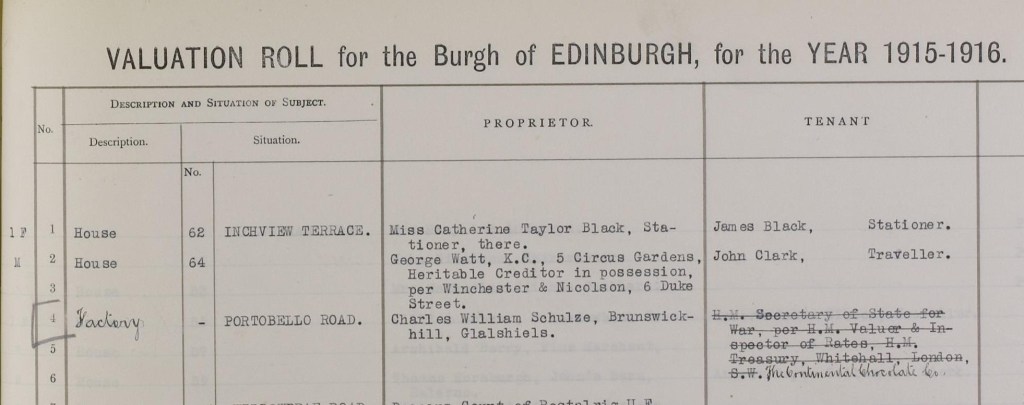
Crown copyright, National Records of Scotland, 1915 Valuation Roll, VR100/325 page 341
Aside from the loss of property during the war, two of Charles and Mary’s sons died while serving with the British Army in France. Private Rudolph Schulze of the Cameron Highlanders died on 18 July 1916 and was buried at Vermelles British Cemetery, near Lens. A little over two years later and with the war in its final stages, his brother, Second Lieutenant Hugh Schultze of the Dorsetshire Regiment, died on 20 October 1918 and was buried in Neuvilly Communal Cemetery located on the Somme.
In memory of the local men who died in the war, a porch and suite of halls was added to St Paul’s Church, Galashiels, as well as a war memorial, to which Charles and Mary made a substantial contribution in remembrance of the two sons they had lost in the conflict.
With his factory occupied by the government, the Schulze family found themselves in financial difficulties and Charles’ mental health was beginning to deteriorate. Throughout the time that the factory was held under government occupation, no payments were made to Charles for his loss of income. Despite receiving no compensation and being unable to continue manufacturing chocolate, Charles was expected to pay the annual burdens and feu duties associated with the land and property. Charles refused to make payment and maintained that he was no longer the owner of the feu and it was the War Office’s responsibility to meet any payments. His legal representation alleged that this belief was encouraged by a ‘mental delusion’. Charles continually repeated this assertion through letters to the King, the Prime Minister, the Secretary of State for Scotland, the Secretary of State for War and the Lord President of the Court of Session. Indeed, Charles had received a large number of enquiries during 1919 and 1920 from parties interested in purchasing the factory. His reply stated that the factory was not his to sell, and therefore no offers could be accepted.
Records of these legal proceedings tell us that Charles’ equipment had been damaged by the military when it was removed from the premises in 1916. Some of the requisitioned machinery was subsequently used by the government at an explosives factory in the Craigleith area of Edinburgh. The cost of repairing and re-installing the equipment at the Schulze factory was calculated at £1,734; a sum that the government agreed to cover. However, the larger claim for rent of £6,487 as a result of the government occupying the factory was not granted.
Consequently, Charles’ refusal to pay feu duties resulted in the superiors of the feu (the owner of the land) resuming possession of the land under a decree of irritancy (a remedy available to a landlord in the event of a breach of contract by his tenant, allowing the landlord to terminate the lease prematurely).
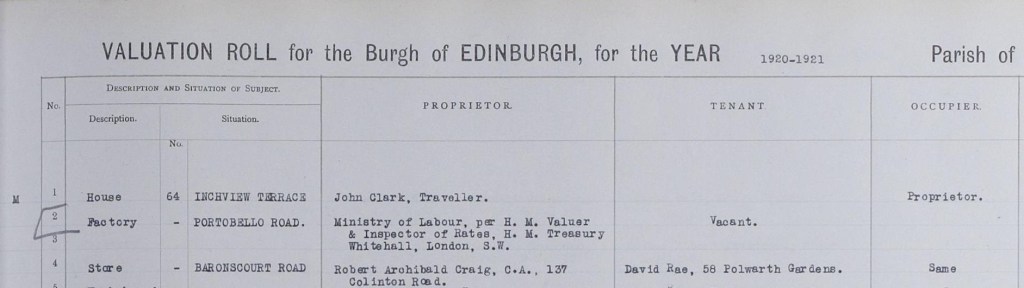
Crown copyright, National Records of Scotland, Valuation Roll 1920-1921, VR100/392 page 189
On 16 July 1923 the whole feu and all of the buildings on the land were conveyed to the Education Authority and Charles lost the whole value of the factory. By this stage, Charles’ health had declined to such a degree that he was no longer able to represent himself and Kenneth Henderson was appointed as Curator Bonis to manage his financial affairs and property in 1927. The rest of the Schulze family were unaware of the legal proceedings until the intervention of Henderson.
Kenneth Henderson, acting on Charles’ behalf, returned to court in 1929 to claim for further compensation of £34,257 in respect of government interference from 30 October 1914 to 25 July 1919. He argued that Charles had been insane when his factory was possessed and had been, therefore, unaware of his rights.
The court rejected appeals for two sums of the amount of £12,889. The first was for a claim against the War Losses Commission in October 1915 by Charles’ sons which had been dismissed by the court. Counsel claimed that the Commission could not have known at the time that there was no possibility of the business being recommenced; both sons were later killed in action and therefore the business was not restarted, resulting in a change of circumstances.
The second claim was for £12,889 in respect of loss of capital invested in the business. Lord Hunter stated that there had been no change of circumstances from previous appeals and no case to exercise discretion in favour of the claimant.
Charles was, however, awarded some compensation for damage caused to the building by the Government’s occupation at a total of £1,734, 18[shillings], and 8[pence].
Charles died, on 27 January 1930, in his family home in Galashiels. He was 90 years old. While Charles’ chocolate business was short-lived, his elaborate chocolate factory survives as a testament to his ingenuity. In 1922, the building was repurposed as the WM Ramsay Technical Institute and converted to flats in 1995. It is now Category A-listed as an important example of early twentieth century industrial architecture.
The story of Charles Schulze and his chocolate factory highlights the hostilities experienced by German communities living in Britain in the first half of the twentieth century. Despite the loss of his business, and tragically, his sons as a result of the First World War, he lived the rest of his life in Scotland, the country he adopted as his own.
Jessica Evershed and Veronica Schreuder
Archivists
With grateful thanks to Caitlin Harkins for suggesting material to include in this article.

