
In the early 1680s, over 600 Scots emigrated from Aberdeen, Edinburgh and Montrose to establish colonial settlement in the eastern half of New Jersey. This venture was backed at the highest level and sought to ensure that Scotland had a stake in the development of the American colonies. It brought together Quakers, Episcopalians and Presbyterians, a tense mix of religious affiliations. Many of the Presbyterians were transported Covenanters and the Quakers too had had their share of persecution.
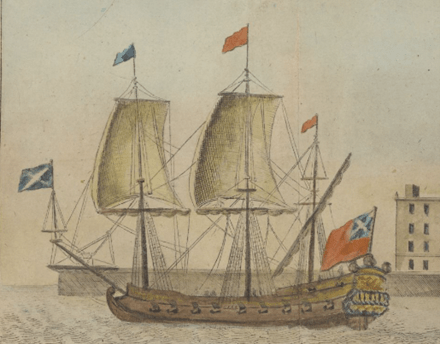
Here Derrick Johnstone, Research Affiliate, Department of History, University of Glasgow introduces his research and explains how he used Scotland’s People and manuscripts held by National Records of Scotland (NRS) in creating a genealogical database and analysis. For a summary of the research, additional content and access to the database, visit East Jersey Bound (https://eastjerseybound.scot).
This article explores how records held by NRS allow us to reconstruct who these emigrants were, where they came from and how they were connected, often in ways not previously recognised.
Who were the emigrants to East New Jersey?
The inspiration for the ‘East Jersey Bound’ project came from exploring the family trees of some of my DNA matches in the USA. I encountered several instances where the connection might involve Scots who were living in New Jersey before 1700. I soon realised that here was a little-known but fascinating episode: a planned venture in the 1680s which contrasts with the failed Darien expedition ten years later.
Many questions filled my mind: Who were they? Why did they leave? What became of them? And how far can you get in finding records for them? This would pose a real challenge, given that few came from elite families, and little has been identified about their origins and connections. Surviving sources are patchy, while New Jersey histories are stronger on what happened to the emigrants than on their roots, motivations and prior relationships.
I began to build a database of the emigrants using genealogical software. Starting points included the Register of the Privy Council of Scotland, Robert Wodrow’s History of the Sufferings of the Church of Scotland and the New Jersey Historical Society’s series of Documents relating to the colonial and revolutionary history of the State of New Jersey. Below is one Privy Council record found in General Register House: a list of those Covenanters banished in August 1685, to be handed over for transportation aboard the Henry and Francis. Many of them did not survive the voyage while others were to leave traces in colonial records.

Part Transcription
Lieth the Eighteenth day of August 1685
Forasmuch as the persones underwritten viz: Mr John Frazer, William Oliphant, John Forman, John Martine, Patrick Cuninghame, John Kincaid, Adam Hood, James Kirkwood, John Hendersone, Peter Russel, Charles Douglas, Robert McQueen, William Turnbull, John McEwan, William Hanna, William Wilsone, John Foord, John Sintoune, Andrew McClelland, Andrew Corbett, John Hunter, John Renny, John Gray, George Moor, John Gilfillan, John McGie, John Turpney, John Urie, James Junck, William Campbell, John Campbell, James Forsyth, Thomas Russell, George Broune, John Pollock, James Restoun, John Clark, John Corsan, Robert Gilchryst, John Smyth, Fergus Grier, William Douglas, John Crichtoun, James Grier, Walter Mcmean, Barbara Cowan, Agnes Corhead, Bessie Gordon, Grissall Gemmill, Margaret McLellan, Elspeth Ferguson, Janet Ferguson, Elizabeth Whitlaw, Janet Lintron, Christian Scott, Katharine Kellie, Annabell Jacksone, Annabell Gordone, Jean Moffatt, Margaret Leslie, Marjorie Cowan, Margaret Miller, Agnes Tannis, & Marion Rennie, George Johnstoun, Christopher Strang, Alexander Dalgleish, John Harvie, Robert Young, and Andrew Patersone, Katharine Govan and Isabell Durie at present prisoners in the Tolbooth of Lieth
I did not limit the exercise to the emigrants alone but gradually sought to incorporate their kin and associates. Mapping this wider population was essential in ascertaining details of the emigrants and in reviewing the influences of family circumstances, kinship networks, religious and social affiliations. Going back a generation or two helps to provide the context and establishes family outcomes more fully, including contrasting the fortunes of those who left and those who remained in Scotland.
Life events from Scotland’s People as a source
Many of the most useful records are available via the NRS service Scotland’s People: birth, marriage and testamentary records. Where parish records survive, baptismal records help clarify family, origins and occupations. Importantly, the names of witnesses reveal social relationships. These witnesses may be close male kin (typically uncles or grandfathers), members of the wider kinship group, and others with standing in the community. This evidence suggests the family’s milieu and can be very useful in building pictures of networks when linked with other records.
Take one example: a record of the baptism in Edinburgh of John Hamilton, child of Andrew Hamilton and Agnes Wilson. Andrew Hamilton is an important figure in the East Jersey story, an early investor before being commissioned by the Scots Proprietors to travel to East Jersey in 1686 to report on progress being made by the settlers and investigate suspected maladministration. The following year he became resident Deputy Governor. Hamilton subsequently features prominently in early histories of New Jersey and Pennsylvania in gubernatory roles and as colonial postmaster-general, setting up a service from New England to Virginia.
Looking at John’s baptism we see amongst the witnesses Sir John Harper, advocate and freemason, lairds Sir William Hamilton of Preston and Thomas Drummond of Riccarton, along with fellow merchants. Simpson and Wedderburn were amongst those at the leading edge of business practice who backed the publication of one of the first accounting guides, Robert Collinson’s Idea Rationaria. These witnesses point to Hamilton’s membership of a pragmatic commercial network, rather than one of Covenanter dissidents or of royalist government placement. The subsequent baptism of his next son, Alexander, reveals a hitherto unknown fact that Hamilton’s trade was as a vintner (wine importer).

Transcription of entry for John Hamilton, 10 July 1685
Captane Andrew Hamilton Merchant & Agnes Willson A Sone n John
w: Sr John Harper of Cambusnethin, Advocat Sr William Hamilton of Preston, Thomas Drumond of Rickarton, Baillie Thomas Willson, Baillie James Southerland, Captane George Wedderburn, Capt Alexander Sympson & James Kirk, Merchants, Mr James Scot Clarke to the Sheriff Court of Lothian & George Robertson, Writer
First-named witnesses can be particularly revealing. In the case of the baptism on 11 March 1683/4 of George Gordon, son of merchant Thomas Gordon and Helen Riddell, the witness was George, Lord Haddo, then Lord Chancellor of Scotland, thus placing Thomas close to the ruling elite. Thomas was another Scots emigrant who was prominent in East Jersey, building a substantial estate, serving on the Board of Proprietors and holding various public offices including Chief Justice. He came from the family of Gordon of Pitlurg and emigrated with his brother Charles. Both as younger sons were unlikely to inherit the family estate and had to seek new opportunities, a common situation for other emigrants from the families of lairds.
Baptism and marriage records on Scotland’s People were helpful in relation to such emigrants but also for indentured servants and transported Covenanter prisoners. Arrivals were recorded in East Jersey in 1683 and 1684 but by name only, and in the case of married women, by their maiden name only. Relationships are not immediately apparent. However, parish records could help. For example, it proved possible to establish that, amongst a group of servants imported for Andrew Hamilton were mason John Hume and his wife, Margaret Dickson (married in Kelso in 1672) accompanied by their daughters, Catherine and Jane. Where such dates could be identified it enabled calculations of the ages of the emigrants, painting a youthful picture amongst the free and indentured emigrants of families with young children and unattached single people.
Overall, marriage records tend to provide less information than baptismal records, though some provide the names of cautioners of the betrothed, typically close male relatives, who had to guarantee that there was no lawful impediment and that marriage banns would be honoured.
Wills, testaments and inventories held on Scotland’s People can be helpful too, where they reveal the names of family members and details of their debtors and creditors. Their value is greater where they relate to emigrants who returned or where they provide illustrations of how families remaining in Scotland fared economically in comparison with their relatives who emigrated.
Digging deeper in NRS collections
I complemented my research using Scotland’s People with access to manuscripts in the Historical Search Room. Port Books (E72 – Exchequer Records: Customs Books) provide details of the emigrant ships (their masters, dutiable cargoes and lead merchants), while contained in the Records of High Court of Justiciary (JC series) are details of the origins and occupations of some of the Covenanters.
There are many manuscript items scattered amongst the ‘Gifts and Deposits’ collections. One of the most productive sources has proved to be the Estate Papers of the Campbell Family, Earls of Breadalbane (GD112/16 – the ‘Breadalbane Muniments’), particularly relevant in researching the involvement of Lord Neill Campbell of Ardmaddie (a younger brother of the Earl of Argyll who was executed after his failed uprising of 1685). Ardmaddie was one of the leaders of East Jersey venture, commissioning the voyage of the America Merchant which left in July 1685. There are also records amongst the Menzies Writs, part of the John MacGregor Collection GD50/186 partly as a consequence of Ardmaddie’s marriage to Susan Menzies in 1684 or 1685. The latter include a remarkable commission given to James Campbell by Ardmaddie and his partner, Edinburgh merchant Mr Robert Blackwood, to ascertain the state of their investment and indentured servants and to sell their property at a knockdown price – this after Ardmaddie had returned to Scotland from 20 months in East Jersey!
Another fruitful source are deeds recorded in the Court of Session Register of Deeds (RD series). These are legal instruments such as bonds, contracts and leases. They offer insights into the commercial and property dealings of the emigrants and associates, illustrating their resources and commitments and revealing more of their networks. Here is another example involving Thomas Gordon. He acted as cautioner (guarantor) for Thomas Pearson, master of the Thomas and Benjamin (one of the emigrant ships in 1684) and Edinburgh lawyer, Mr David Vilant. In this deed Pearson and Vilant have negotiated with Sir William Drummond of Cromlix, Master of Ordnance in Scotland, the supply of 500 pounds of gunpowder for protecting the ship. The deed shows that Gordon was in the pay of the Lord Haddo (as his ‘servitor’) and that Vilant was more centrally involved in the arrangements for the voyage than previously known. Furthermore the deed revealed the participation of another merchant, James Guthrie, the second cautioner, and helped to confirm that the Samuel Guthrie who died in East Jersey in 1685 was his brother.

Transcription of extract
The NRS contribution to my research
By combining these sources from Scotland’s People and manuscripts held by National Records of Scotland I have been able to progress my research in ways not otherwise possible. I am very grateful to NRS for enabling access to these records.
My database now contains over 340 baptismal records from Scotland’s People – the largest single source – closely followed by citations from the recently digitised New Jersey Early Land Records project, an excellent resource for tracking the emigrants. The database also contains over 70 marriage records and nearly 50 wills and testaments from Scotland’s People and nearly 200 items from the NRS Catalogue.
Piece by piece these have been enormously useful in triangulating evidence and in helping to understand who the emigrants were and where they came from and the nature of their kinship and other connections.
Derrick Johnstone
University of Glasgow, Research Affiliate, Department of History
Derrick Johnstone is a Research Affiliate in the Department of History at the University of Glasgow in Scotland, having completed his M.Phil. dissertation, Scots Emigrants to East Jersey 1682–1702: Motivations and Outcomes in 2025 https://theses.gla.ac.uk/85247/. He has been a member of the Scottish Genealogical Society for 10 years and is Secretary of the Old Edinburgh Club, the city’s history society.
 Open Book