
The Milano Cortina 2026 Olympic Winter Games will take place between 6 to 22 February this year. Athletes from all over the world will compete in 16 disciplines hoping to win an Olympic medal. Team GB have had regular success in the sport of curling, with both the men’s and women’s team bringing Olympic medals home. This year, as in previous Games, Team GB Olympic curling squad is almost entirely made up of Scots. We look at the history of Scotland’s ‘ain (own) game’, as it is often called, in the collections of the National Records of Scotland (NRS) and possibly the first ever mention of a curling game.
The Little Ice Age: 1550-1700
Northern Europe, including Scotland, experienced extremely low temperatures in the mid- 16th to 18th centuries, although some researchers have extended this period to 1300-1850. During this time new sporting pursuits and pastimes were devised to take advantage of the snowy and frozen landscapes.
The Scots took advantage of frozen lochs, rivers and ponds to play the game of curling which saw rounded stones (known as ‘loofies’ probably originating from the Scots word for hand or palm ‘loof’) of hard igneous rock (usually granite) thrown across the ice to get as close to a target as possible. The route the loofie took was influenced by the sweeping of the ice (to make the ice smoother) by brooms in the hope it reached its target. It is thought to be one of the oldest team sports in the world, disputedly beginning in 16th century Scotland and played across the Low Countries (Belgium, the Netherlands and Belgium) as depicted by Pieter Bruegel the Elder’s ‘Hunters in the Snow’ (1565):
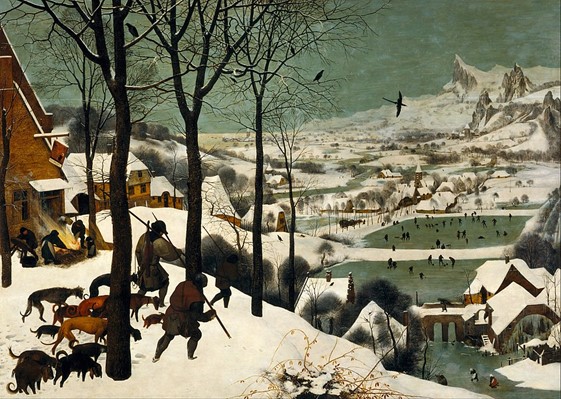
Image credit: WikiCommons. Public domain.
Curling became a popular sport, particularly across the Lowlands of Scotland. It was played whenever frozen bodies of water could withstand the energetic game. The Smith Museum in Stirling claims to have the world’s oldest curling stone (or loofie) with the date 1511 engraved on one side. This engraving may have been added at a later date, but the first mention of curling in written form appears just 30 years after this in 1540 or 1541. In the protocol book of an unnamed Notary Public (a practising solicitor who verifies legal documentation or administer oaths, among other duties) of Paisley is a note of a contest on ice. The entry is in Latin, but we have attempted a translation:
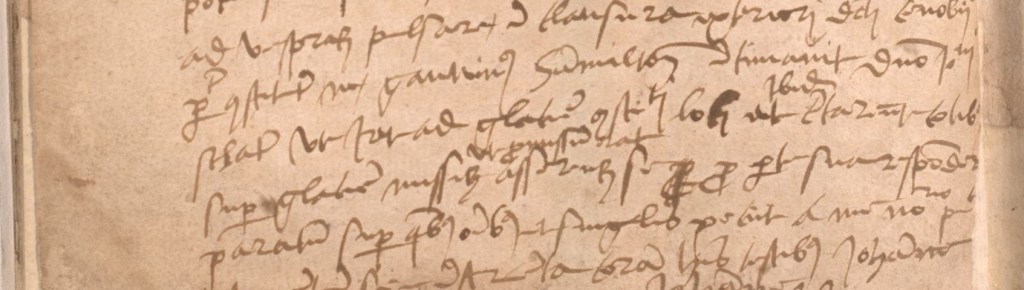
National Records of Scotland, NP1/198 page 14 (detail)
magister gawinus hammiltoun intimavit domino Joanni sclater vt let as glaciem constituti et ibidem certarent cotibus super glaciem missis vt promissum erat asserens se pro parte sua respondere paratum
“Master Gavinus Hammiltoun intimated to Lord John Slater that the ice should be set up and that they should compete there with the stones sent over the ice, as had been promised, asserting that he was ready to answer for his part”
Unfortunately, the winner of this game is not recorded, but it contributes to the notion that Scotland were playing curling in the mid-16th century, 25 years before Bruegel’s painting. There are no known earlier manuscripts which record the sport being played anywhere in the world.
Possibly the earliest painted depiction of curling taking place in Scotland is an artwork on display at Traquair House at Innerleithen in the Scottish Borders. Simply entitled ‘Curling’ the canvas dates from around 1700 by an unknown artist.
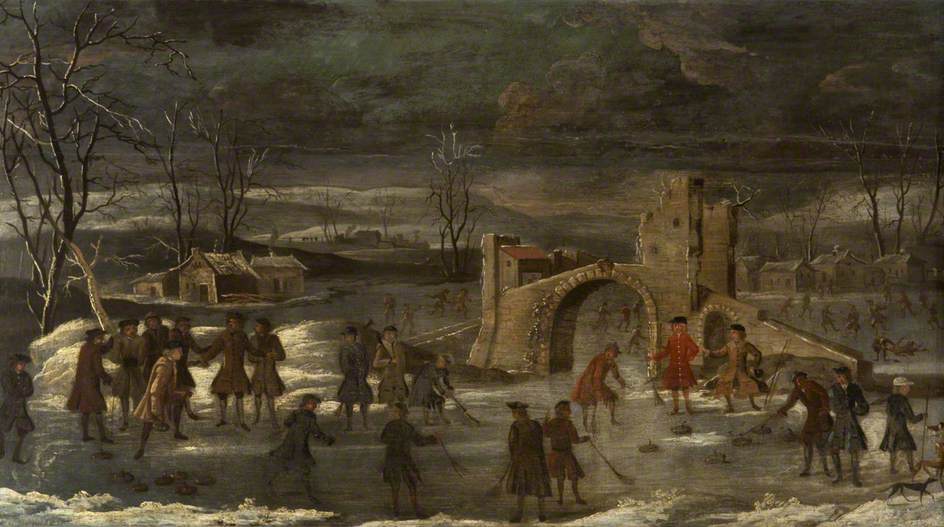
Image credit: Traquair Charitable Trust via Art UK
The records of many Scottish curling clubs and societies can be found in the collections of NRS, and these can be searched via the online catalogue. The Royal Caledonian Curling Club (RCCC) became the national governing body of the sport in 1838. In 1843 Queen Victoria was introduced to curling and gave the organisation its royal charter. The RCCC helped draw up the official rules of the game and supported thousands of members across the country.
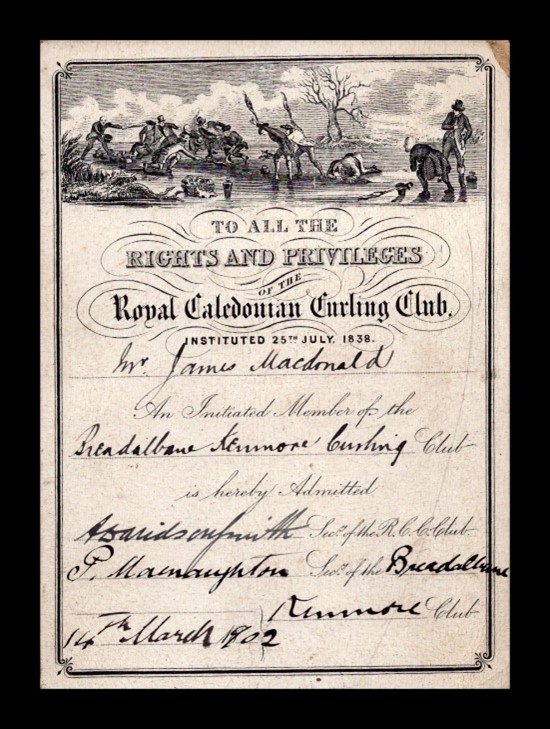
NRS, GD1/641/31
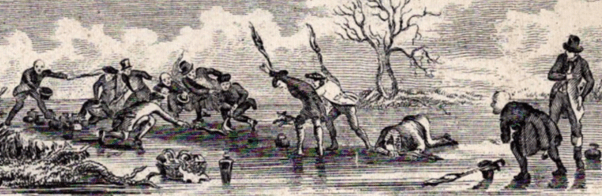
NRS, GD1/641/31 (detail)
Across Scotland, ‘bonspiels’ were organised, where different clubs or parishes came together in curling competitions. One was organised in 1953 to celebrate the coronation of Elizabeth II at Crossmyloof, Glasgow, with 140 competitors:
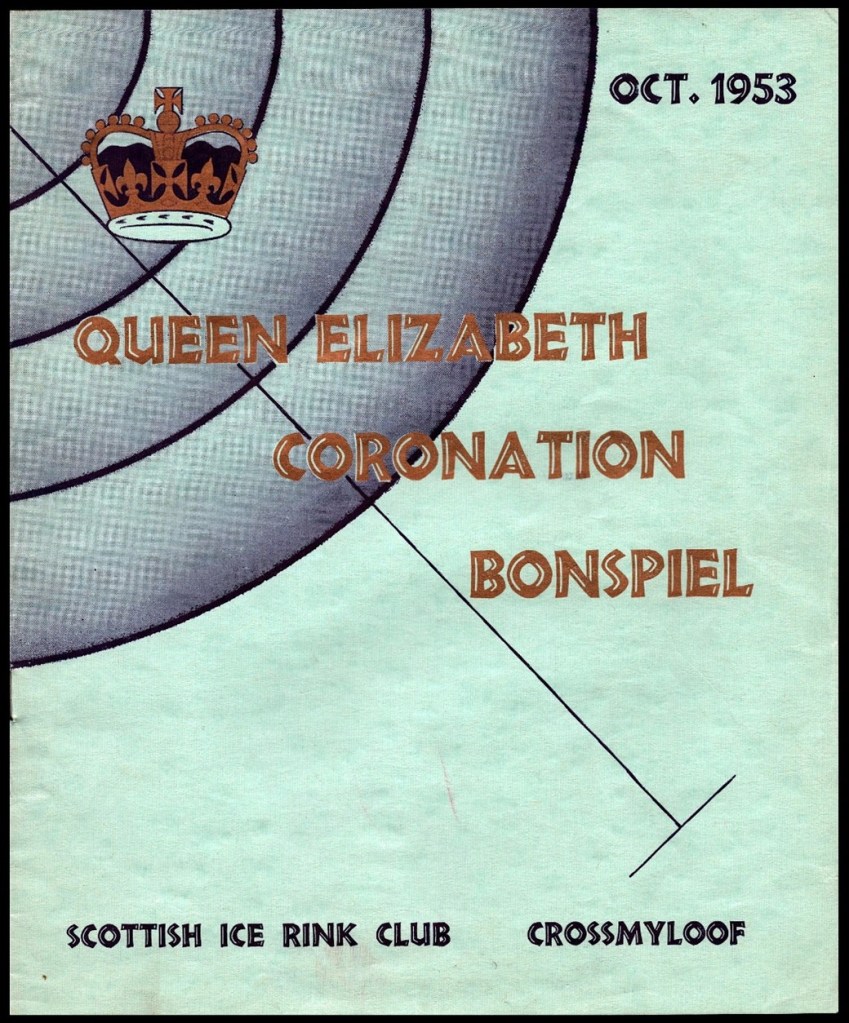
NRS, HH91/472
With the sport’s popularity growing in Scotland in the 19th century, nearly every parish had a ‘curling pond’. Many of these can be found in the Ordnance Survey Name Books (accessible on the Scotland’s People website), often along with a small building where curling stones and equipment could be safely stored out of season.
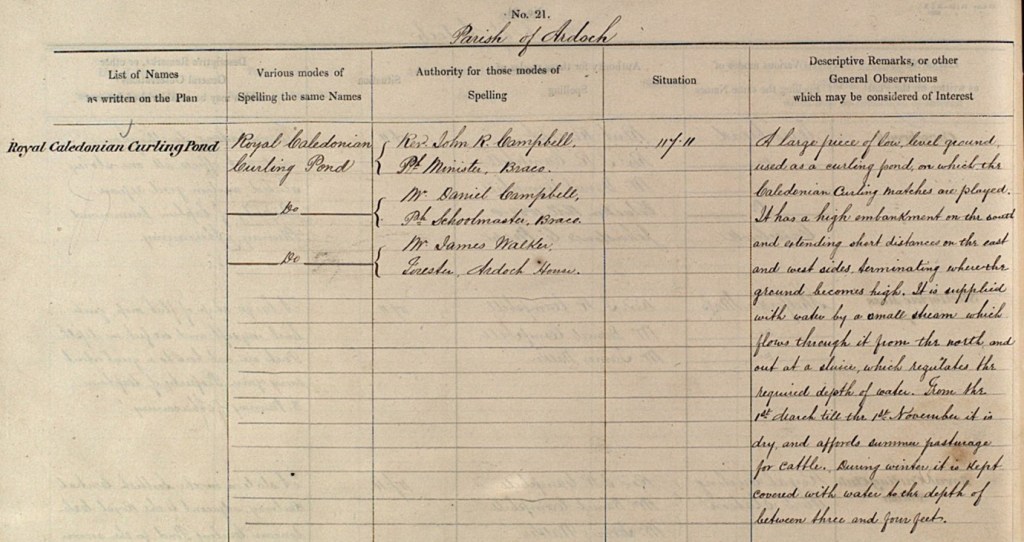
NRS, OS1/25/6/1 page 66
Demand for the manufacturing of the stones or loofies was high. At this time there were two main Scottish quarries where granite was harvested for the stones. These were located near each other in Ayrshire, south west Scotland at Crawfordjohn and the isle of Aisla Craig. T. & A. Kay of Mauchline, curling stone manufacturers, were founded in 1851 and are still in operation today (now known as Kays Scotland). They secured exclusive permission to harvest granite from Ailsa Craig from the Marquess of Ailsa.
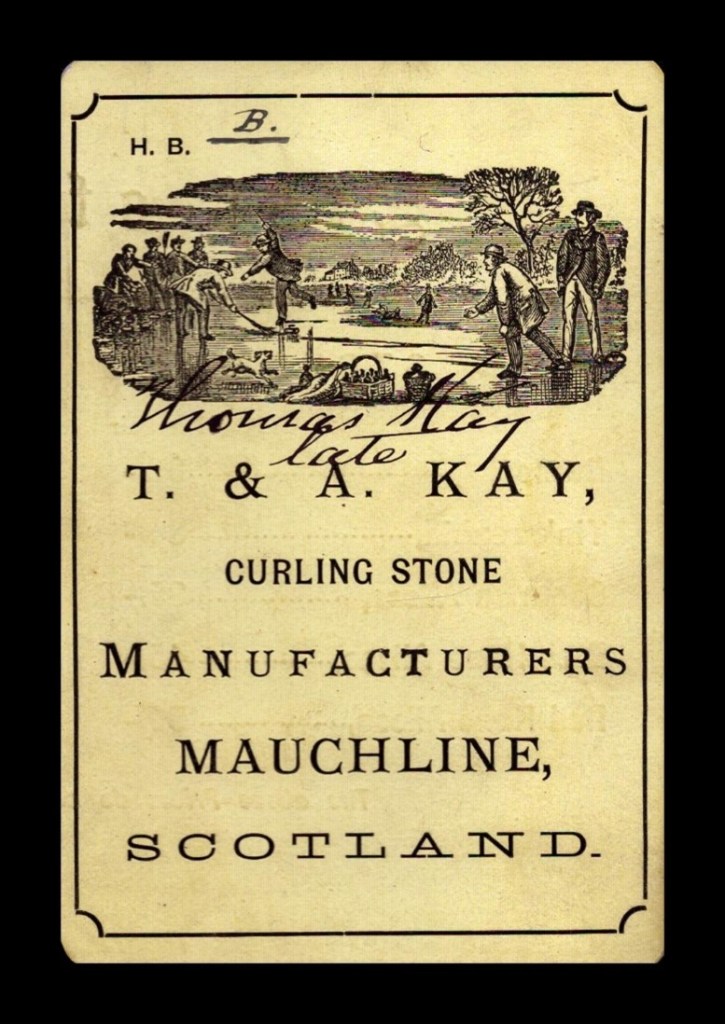
NRS, CS96/6543
Today Kays Scotland are sole providers of curling stones for the World Federation of Curling and the Winter Olympic curling tournaments.
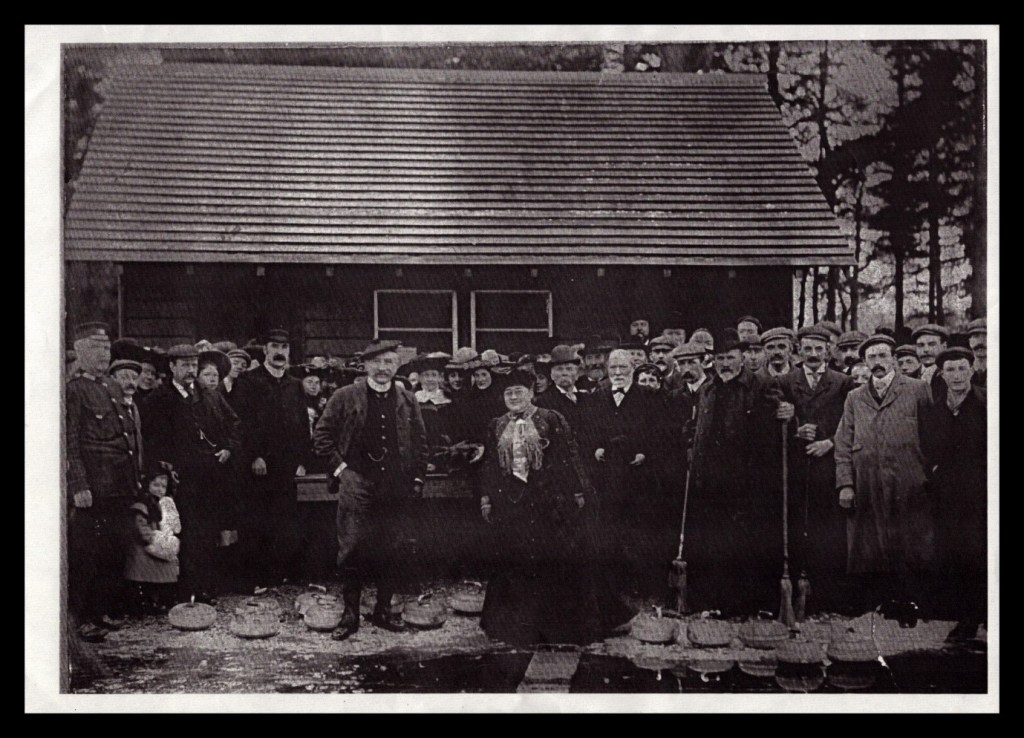
NRS, GD1/1419/44
The sport of curling continues to be popular in Scotland. The Royal Caledonian Curling Club is now known as Scottish Curling and supports local competitions and offers introductory sessions to beginners. You can find out more on their website.
We will be cheering on the Mixed Doubles Curling Team along with Team Mouat (Team GB’s men’s curling team) and Team Morrison (Team GB’s women’s team) and hope that this article inspires you to watch the action and even perhaps have a go at curling yourself!
Jessica Evershed
Outreach and Learning Archivist
 Open Book
One thought on “Scotland’s ain game of Curling”