Retracing Sancho’s Steps: Countertenor Visit to the National Records of Scotland
“Inverary is a charming place–the beauties various–and the whole plan majestic…We had herrings in perfection…The Loch-Loman–Ben-Loman–Domiquith–and Arsenhoe–with Hamilton and Douglas houses–are by much too long for description by letter.–We paraded to Edinburgh last Friday in a post coach…and dined at Lord Chief Baron’s…”
Letters of the Late Ignatius Sancho: An African, to which are Prefixed, Memoirs of his Life, 1st edn., 2 vols (London: John Nichols, 1782)
When Charles Ignatius Sancho (1729?-1780) penned these words to a friend in London during the early 1770s, he was travelling through Scotland for the very first time. Who did Sancho encounter during his journey through the Highlands? Which Scottish melodies caught his ear and later found their way into his compositions? In September 2025, the Countertenor team journeyed to Scotland to answer these questions, and to retrace the footsteps of one of Britain’s most remarkable eighteenth-century figures.
Sancho was one of the only Black musicians to publish original compositions in Britain before the nineteenth century. A formerly enslaved African, Ignatius was a Georgian polymath most famously known for being one of the earliest Black English voters and for the posthumous publication of his Letters. He spent most of his life in domestic service before running a grocery store in the heart of Westminster. Sancho worked for three generations of the aristocratic Montagu family. In 1767, Elizabeth Montagu married Henry Scott, 3rd Duke of Buccleuch (1746–1812) whose family seat was in Scotland. Elizabeth became the Duchess of Buccleuch, and in the early 1770s, Sancho travelled with the pregnant Duchess to Scotland. Sancho’s published Letters and later compositions suggest the visit left a profound impact on his artistic practice.
Countertenor, an AHRC-funded research project, focuses on Ignatius Sancho’s music as a case study for exploring broader Black narratives in the arts. The project aims to diversify the musical canon through research and performance into early Black music and opera. The team is led by Grammy-nominated American countertenor Reginald Mobley. Reggie, an advocate for diversity in music, brings both personal and professional expertise to the project, using his own experiences to explore and illuminate Sancho’s in an authentic and creative way.
Left to right: Craig Thomas, Assistant Archivist for Buccleuch Living Heritage Trust, Olivia Howarth, Private Records Archivist, Ben Park, Countertenor musical director, Reginald Mobley, Countertenor research lead, Dr Alan Borthwick, Head of Medieval and Early Modern Records, May Sumbwanyambe, professor and playwright, Liberty Collard, Countertenor research assistant.
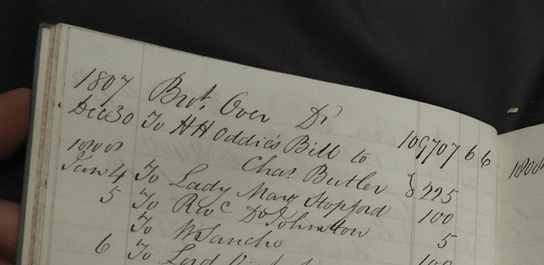
In order to understand Sancho’s connections to Scotland better, the Countertenor team visited the National Records of Scotland (NRS) to search for references to Sancho in their archival collection. NRS holds the ‘Papers of the Montague-Douglas-Scott Family, Dukes of Buccleuch 1165-1947’ (see; GD224), a logical place to start! While direct references to Ignatius in GD224 are scarce, a reminder of how enslaved and servant voices are often absent from surviving records, we discovered valuable information about the household’s activities. For example, we saw bills paid to his son, William Sancho, who became the unofficial librarian for the Buccleuchs in the early nineteenth century. This demonstrated the longevity of the relationship between the Buccleuch and Sancho families, plus the longstanding Scottish connections, which subsequently helped us to understand the relationship between Ignatius and Elizabeth better. This collection proved both illuminating and tantalising for our broader research project.
Payments made by Her Grace the Duchess of Buccleuch, January 1806 to May 1811, NRS GD224/1092/3
Many of Sancho’s musical arrangements have explicit nods to Scotland. In his ‘New Collection of Songs’, Sancho composed ‘Kate of Aberdeen’ to words by John Cunningham (1729–1773), a Scottish poet [A Collection of New Songs Composed by An African Humbly Inscribed to the Honble. Mrs James Brudenell by her most humble Devoted & Obedient Servant, The Author. [c. 1769]. Sancho also named one of his Country Dances in ‘Cotillions &c.’ after Dalkeith Palace, one of the Buccleuch properties that he visited during his travels [Cotillions &c. humbly dedicated (with permission) to the Princes’s [sic] Royal, by Her Royal Highness’s most obedient servant Ignatius Sancho. London: printed for C. & S. Thompson, no. 75, St. Paul’s Church Yard [c. 1770]. Country dances were performed at Georgian society assemblies, balls, and private entertainments. By dedicating a dance to Dalkeith, Sancho was both honoring his time in the house, his patrons and potentially seeking to claim his place as a composer worthy of aristocratic attention.
Sancho was evidently inspired by the places he visited and the people he met in Scotland. Therefore, another key motive for the visit to NRS was to explore potential musical influences that Sancho may have heard during his travels in Scotland. The 1770s were a golden age for Scottish music collection and publication—Robert Burns would soon begin collecting folk songs, and Scottish fiddle music became fashionable in London salons. The distinctive rhythms, modal scales, and ornamentation of Scottish music undoubtedly influenced his later compositions, even in works not explicitly labelled as Scottish.
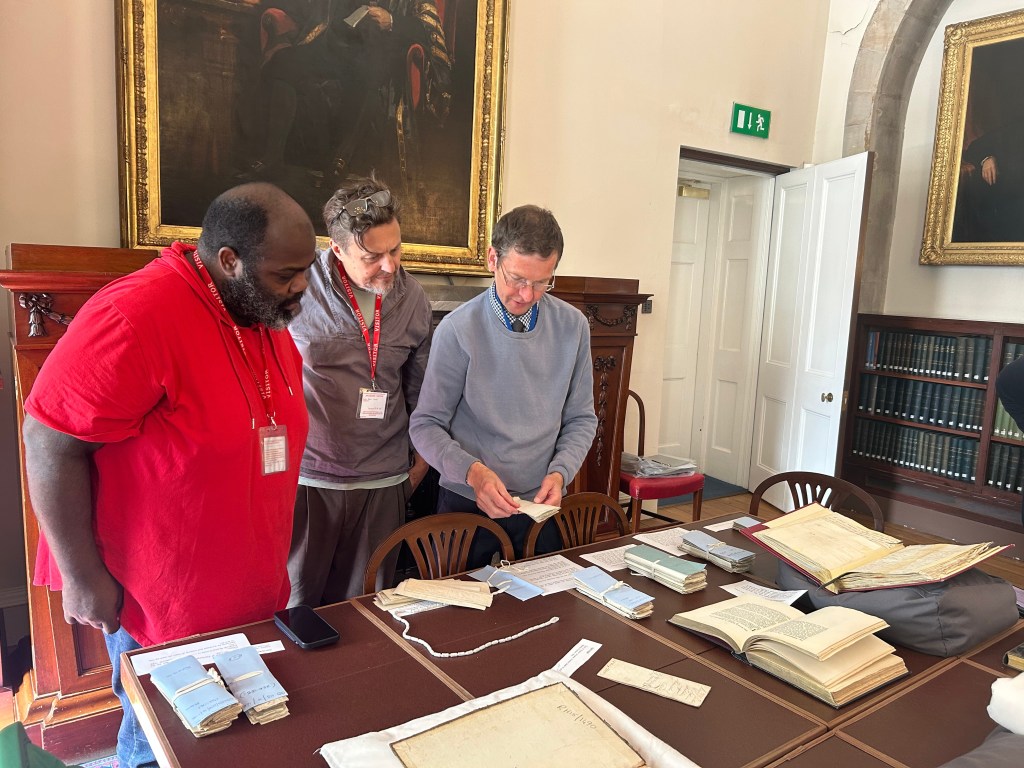
To help with this research, we explored the NRS collection of records associated with The Edinburgh Musical Society (1728-1801). Accounts and receipts revealed a vibrant musical scene, the very society circles in which the Duchess would have moved. Bills for musicians and instruments gave us insights into what type of music Sancho might have heard: fiddles, harpsichords, and the distinctive sound of Highland bagpipes mixing with classical European traditions. The Society featured both Scottish traditional music and fashionable Italian opera. This rich tapestry gives us a new insight and context into which to place Sancho’s music.
Photo description: Reggie, Ben and Alan exploring records of the Edinburgh Musical Society
Our Countertenor visit to NRS, therefore, offered an insight into the intriguing archival traces of Ignatius Sancho’s Scottish journey. By piecing together records in NRS – from the Buccleuch household accounts to the Edinburgh Musical Society- our visit proved invaluable in reconstructing the musical and social world Sancho inhabited during the early 1770s. The visit helped the project continue its overall aim of recovering and celebrating early Black artistic contributions. We are so grateful to the team at the archive for hosting our visit – it certainly gave us a lot of new information and ideas to ponder over as we continued on our own Scottish tour!
If you wish to get involved or find out more about the Countertenor project, you can visit our website https://www.reginaldmobley.com/blog-countertenor, or you can directly contact Producer Tracy here, we’d love to hear from you.
by Liberty Collard Countertenor Research Assistant



 Open Book