
Warning
This contains materials and references to homophobic language and themes which may be triggering for some individuals. Please take this into account before reading.
Protests
Lark in the Park was a public event organised by Scottish Homosexual Action Group (SHAG) to increase gay and lesbian visibility. Section 28 had been introduced only days prior. This event first took place in Edinburgh’s Princes Gardens in 1988, predating the first large-scale Scottish Pride march which took place in 1995.

The event included music, comedy, performances and speeches. It was organised to celebrate LGBTQ+ lives and increase visibility in the wake of Section 28’s introduction and increased attacks on LGBTQ+ rights.
While Edinburgh District council had agreed to host the event in 1988, records reveal that the following year (1989), SHAG’s application for a grant to host Lark in the Park again was rejected. Edinburgh District council claimed this was on the grounds of a possible breach of Section 28.
‘The Final Fling’
‘Clause 28, the Final Fling’ was an event organised by SHAG; it took place days before Section 28 came into effect. Actors (including Ian McKellen), musicians, comedians and TV celebrities all took a stand against it.
SHAG made their opposing stance very clear, Section 28 was not going to restrict LGBTQ+ lives: “Let’s show them that it takes more than a few bigots at Westminster to stop us coming out and having fun”.
The work of SHAG and others to organise events and protests against Section 28 across the UK were instrumental in raising awareness. This was supported by celebrity endorsements and increased LGBTQ+ visibility.
Lesbian Avengers
The Lesbian Avengers were a direct-action group created to increase visibility of lesbian issues. Originating in New York, the group expanded worldwide – including its Glasgow Chapter. The group was active in the fight for LGBTQ+ rights across Scotland.
Archived in the Glasgow Women’s Library are records of the protests and materials used by the Lesbian Avengers. In 1995 they demonstrated outside the Mitchell Library in Glasgow against the ban of the ‘Pink Paper’, a LGBTQ+ newspaper in all Glasgow libraries (a result of Section 28). The group highlighted that banning gay and lesbian materials was in direct opposition of Mitchell Library founder, Stephen Mitchell’s intentions to “represent every phase of human thought and every variety of opinion”.
The repeal campaign
Keep the Clause
After devolution, the new Scottish Government proposed repealing Section 28. However, there was resistance on the basis of protecting young children.

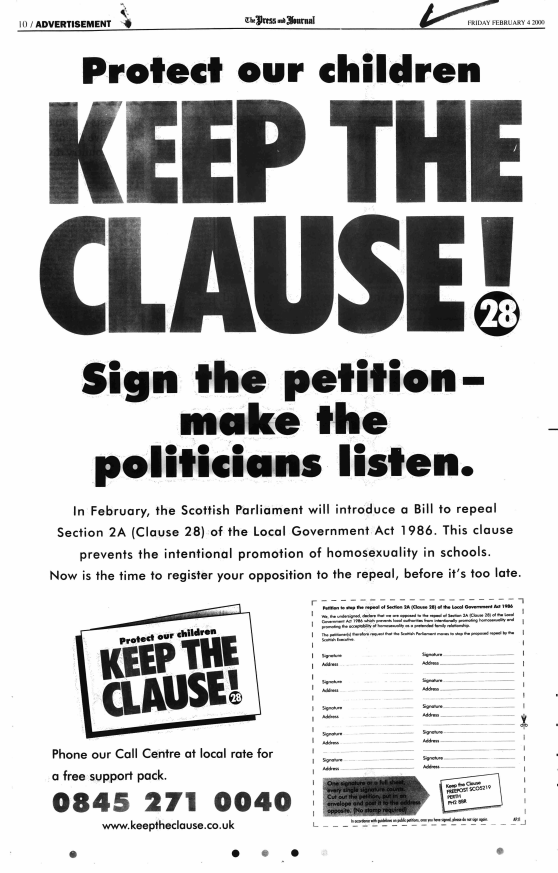
The Keep the Clause campaign opposed the repeal but not “based on intolerance or homophobia, but a genuine concern about the erosion of traditional family values and protecting children from inappropriate campaigning by minority rights groups.” As stated in the stage one report on the Ethical Standards in Public Life etc. (Scotland) Bill.
The “Keep the Clause” campaign submitted a petition to the Scottish Parliament (NRS, SCP2/1/5/183). With 120,000 signatures, the petition asked for the repeal to be stopped. In the event this was unsuccessful, it called for new legislation to be introduced that would give the same safeguards to children as Section 28.
The campaign claimed that Scotland was on “a path that is eroding traditional family values for the sake of political correctness.” This mirrored the words of Margaret Thatcher’s speech at the 1987 Conservative part conference, before the introduction of Section 28: “Children who need to be taught to respect traditional moral values are being taught that they have an inalienable right to be gay.”
Below is an example of the Keep the Clause petition that was included in the Aberdeen Press and Journal in February 2000, alongside other newspapers, digitised and available via the British Newspaper Archives.
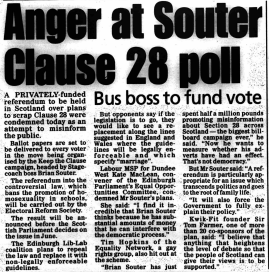
A prominent figure in the ‘Keep the Clause’ campaign was Scottish businessman Brian Souter. Souter funded the campaign to hold Scotland’s only referendum on a moral issue through a private vote. The referendum asked if Scottish people were in favour of keeping or repealing Section 28. The result showed 86.8% of the votes casts opposed the repeal as put forward by the Scottish Parliament. However, with 3,970,712 papers posted out, and most ballots left unanswered, this referendum has been criticised as nothing more than a “glorified opinion poll” by then MSP Wendy Alexander, stating that it had no political strength.
Scottish School Board Association (GD529/8/3)
The Scottish School Board Association (SSBA) was a national organisation founded in 1991 to represent the interest of all school boards across the country. They are an important representative of parents and teachers to understand the debates around Section 28.
The SSBA opposed the repeal of Section 28, stating it “does not have a problem with the discussion of homosexuality in schools in appropriate circumstances and contexts”, however it “does have a problem with certain literature pertaining to the subject which may make its way into schools”.
The stage one report on the Ethical Standards in Public Life etc. (Scotland) Bill reveals that “Ann Hill of the Scottish School Boards Association (SSBA) [said] that Section 28 protects young children from exposure to “gay” pornography “(The Scotsman 14th December 1999). This rhetoric may also have influenced many of the boards and parents – despite the inaccurate claim.

Of the 777 boards that the SSBA represented, a significant proportion opposed the repeal of Section 28. The results were as follows:
| Backed the repeal | Opposed the repeal | Revised Guidelines | Undecided | Total | |
| Results | 90 | 358 | 310 | 19 | 777 |
Although, it’s important to note that the majority of boards were in favour of revised guidelines, and the repeal, compared to those totally opposed. The Scottish Government revised sex education guidance for schoolteachers in light of the repeal of Section 28 for clarification and to formally address SSBA’s concerns.
Repeal
In 1999, Scotland gained new powers under Scottish devolution. Local governance and education were delegated as devolved issues which the newly established Scottish Parliament could control independently from Westminster.
Section 28 was repealed in Scotland under the Ethical Standards in Public Life etc. (Scotland) Act 2000. It passed with 99 votes for and 17 against, with 2 abstentions.

The majority (83%) of Scots in 2000 believed that homosexuality should be tolerated and 59% believed to ‘teach children that homosexuality is neither right nor wrong, and should be tolerated as a way of life’ [source].
Section 28 would be repealed in England and Wales three years later, in November 2003.
Ben Scott
Customer Service Officer
 Open Book