
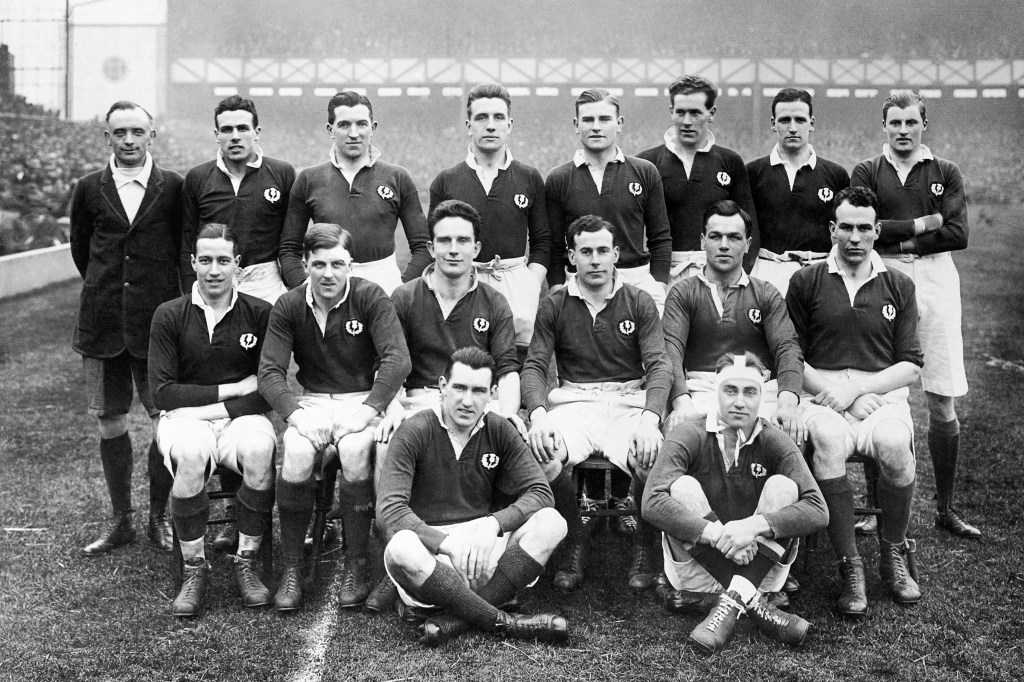
‘Will it be Flodden or Bannockburn?’ wrote the Daily Express on 20th March 1925 about Scotland’s final fixture of the 1925 Five Nations season. A game which was to take place on 21st March 1925 at the newly built Murrayfield Stadium, and just so happened to be a Grand Slam decider against their old rival, England. Indeed, the game was a resounding success for Scotland winning 14-11, and this victory ushered in a golden period in Scottish rugby.
In this article we celebrate the 100th anniversary of this historic venue and discover the stories of Scotland’s first Murrayfield team by exploring the records held by the National Records of Scotland (NRS) through our online service Scotland’s People.
- Scottish Rugby prior to 1925
- Murrayfield is born
- 21st March 1925
- The Captain
- Scotland’s first try
- Winning Drop Goal
- The Final Whistle
- A Gaelic Touch
- Legacy
- Resources/further reading
Scottish Rugby prior to 1925
The first international men’s rugby union match was played between Scotland and England at Raeburn Place, Edinburgh, on 27th March 1871 in front of 4,000 fans. Scotland won 1-0, with a controversial try. In the early days of international rugby tries were not worth 5 points and instead provided the opportunity to take a kick at the posts for 1 point.
Soon the game had developed technically and international games had materialised into a tournament between the Home Nations, with Ireland and Wales joining in 1877 and 1883, respectively. The tournament was further expanded to include France in 1910, then named the Five Nations. When Italy joined in 2000 it became the Six Nations.
In addition to winning the championship, two other trophies were contestable for Scotland. The first was the Triple Crown. This was awarded for beating the three other home sides in the British Isles and was the spiritual continuation of the Home Nations. However, as no trophy was created for this accolade until 2006, it was known as the “Invisible Cup”.
The second trophy Scotland competed for was the Calcutta Cup. The trophy was made from the remaining silver rupees of the Calcutta Rugby Club and gifted to the English Rugby Football Union in 1878. This trophy is awarded to the winner between Scotland and England in their annual fixture. The teams first played for the Trophy in 1879 at Raeburn Place ending in a draw.
After their first international victory in 1871, Scotland remained a successful team in the 1880s, notably in 1883, 1884, 1886, and their first championship win in 1887, but were deprived of the triple crown success – on all occasions – by England.
In the 1890s Scotland tasted success at last, with their first joint Championship, Calcutta Cup, and Triple Crown win in 1891 and again in 1895. In 1897 the Scottish Rugby Union purchased their grounds at Inverleith. They were the first of the Home Nations to own their own rugby field and stand.
The early 20th century also saw Triple Crown success and championship wins in 1901, 1903, 1904, and 1907. On each occasion spectator attendance grew with a record 40,000 strong crowd at the Scotland-England game at Twickenham on 20th March 1920. Scotland were joint winners with Wales and England in 1920.
Murrayfield is born
Due to the rise in popularity of the game, it was clear by the early 1920s that Raeburn Place and Inverleith grounds were ill-equipped to hold such matches. It was decided a new venue was required.
The Scottish Rugby Union considered various locations. However, the Edinburgh Polo Club grounds located at Roseburn Street, Murrayfield, Edinburgh, were deemed to be the perfect location. The land was purchased by the Scottish Rugby Union from its owner Sir Archibald Spencer Lindsey Campbell of Succoth, Baronet, by sasine for £4752 5 shillings.
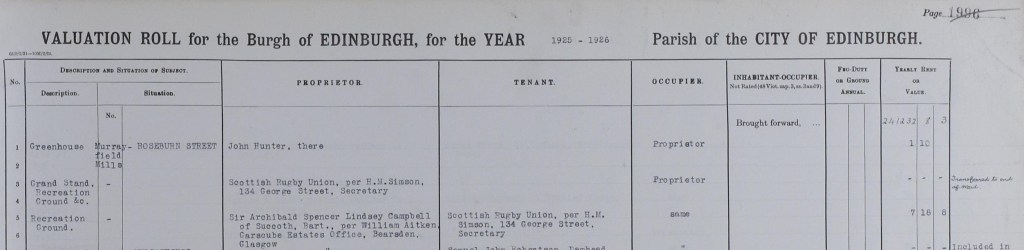
NRS, Crown copyright, Valuation Rolls, Edinburgh Burgh, VR100/495, page 195.
The 1925 valuation roll for Edinburgh Burgh shows the Scottish Rugby Union as owners of a grandstand recreation ground at Roseburn Street (Murrayfield) and as tenants on a nearby recreation ground owned by Sir Archibald Spencer Lindsey Campbell of Succoth, which is valued at £7 18 shillings 8 pence. Interestingly, the value of Murrayfield has been hand-written onto the last page of the 1925 valuation roll at £1,400.

21st March 1925
The 21st March 1925 was an opportunity for Scotland to finally become the outright champions of the 1925 competition. Scotland got off to a flying start defeating France at home, playing their last international at Inverleith. They then went on to defeat Wales and Ireland, playing away.
Last on the list was England, who had also beaten Wales and drew with Ireland. Scotland were most assuredly the underdogs in this fixture. They had not beaten England since 1912, and England had won the last two championships.
The opening match at Murrayfield was billed to be the Grand Slam and Triple Crown decider. With the Calcutta Cup also on the line, the stakes for Scotland could not have been higher.
On the day of the game the atmosphere around Edinburgh was palpable. Extra buses and horse drawn carriages were arranged to transport the roughly 70,000 fans to the ground. Space was also arranged for around 150 motor cars.
Amateurism was the name of the game, and all the players on both sides held full-time careers alongside their international duties. Scotland player Jimmie Ireland recalled that “I asked for the Saturday off to play for Scotland, they asked if I was sure that I needed the whole day. A chap in the accountancy office wondered if I would be ok with just a half day.”
The Scotland team met at the North British Hotel (now The Balmoral Hotel), due to the changing rooms at Murrayfield not being completed in time for the game. Scotland player Doug Davies described how “They were still working on the place when we got there. The smell of freshness was everywhere and there were still bits and pieces to be finished off.”
The Captain

The team was led by their captain Phil Macpherson , who played in centre position. In the 1925 match he was described as a “Marvellous player” and “Wonderful Captain”. This was Macpherson’s first year as Scotland captain.

NRS, Crown copyright, Statutory Register of Births, 1903, 102/56 page 19.
Macpherson was born George Philip Stewart MacPherson on 14th December 1903 at Speyville, Newtonmore, Kingussie to Thomas Stewart Macpherson, an Indian civil servant, and Helen Cameron. Prior to his Scotland captaincy, his rugby career included playing centre/stand-off for Edinburgh Academicals FC and for Oxford University RFC. He died in 1981.
Scotland’s first try
After all, the build-up and anticipation, the referee blew his whistle and the first game at Murrayfield kicked off. The forwards of both sides clashed upfront, seeking to drive the other team back towards their posts. The backs , typically smaller, faster men, stood wide and sought any opportunity to break through towards the line or kick the leather off the ball.
To Scotland’s dismay, it was England’s second-row William Luddington who opened the scoring, with a penalty bringing the score to 0-3.
However, unphased by England’s early lead, Scotland began to move the ball and gain territory. Scottish scrum half , James Benzie (Jimmy) Nelson, spotted a gap in the English line and darted through. Captain Macpherson recalled how he ran 25 yards breaking many English tackles to score under the posts.

NRS, Crown copyright, Statutory Register of Births, 1903, 622/1/290 page 97.
Nelson was born James Benzie Nelson on 9th February 1903 at Foune Terrace in Glasgow, to William Nelson, a writer and Mary Benzie. Nelson played for Glasgow Academicals. Nelson formed a duo with fellow Scottish player Herbert Waddell. Their half back pairing was said to be “the fear of all Scottish club and international opponents.” After his playing career, he served on the Scottish Rugby Union committee for West, from 1933 to 1936. Nelson died in 1981.
As the game continued it did not drop in intensity and, with around 20 minutes left to play, a controversial try was scored by Scotland winger Arthur Cooper Wallace. Despite the protests from English players, coaches, and fans alike that Wallace’s foot was in touch (out the field of play ), the try was awarded. This brought Scotland to within a point of victory .
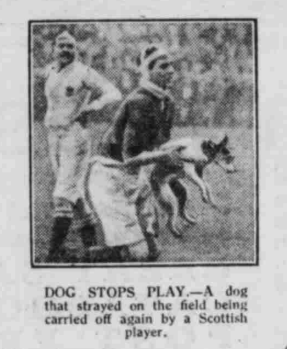
However, play was briefly disrupted when Murrayfield experienced its first recorded pitch invader; a Terrier dog broke onto the field and needed to be carried away from danger by a Scottish forward.
Winning Drop Goal
Time was quickly running out for the Scots; they thought they had pulled ahead when Wallace broke towards the try line , until play was pulled back for a forward pass. Scotland came close again when fly half Herbert Waddell tried to kick the ball between the goal posts for four points and the ball narrowly missed its target.

With five minutes left to play Scotland manufactured another opportunity to take the lead. With possession 25 metres from the English line, J.B Nelson passed the ball out wide to Herbert Wadell. Despite his earlier miss he angled to take the kick and dropped the ball on his foot. He lifted the ball high into the Murrayfield sky and, as it flew towards the posts, the crowd at Murrayfield fell silent in anticipation. The fate of the championship rested on this kick. To the delight of all Scots in the stadium the ball was slotted through the posts and Scotland took the lead.
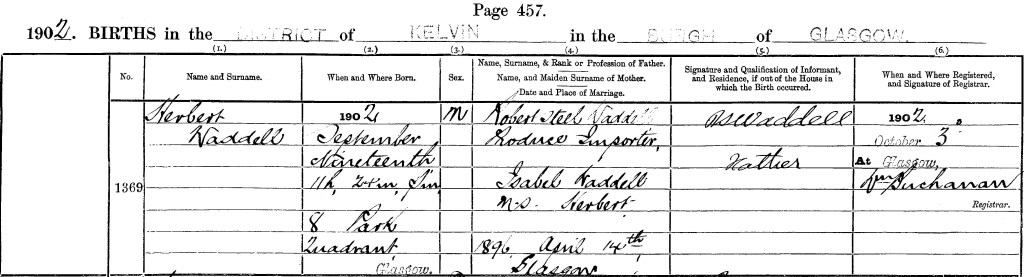
NRS, Crown copyright, Statutory Register of Births, 1902, 644/9 1369 page 457.
Waddell was born Herbert Waddell on the 19th of September 1902 at 8 Park Quadrant, Kelvin, Glasgow, to Robert Steel Waddell, a produce importer and Isabel Herbert. He began his rugby career as a fly half for Glasgow Academical and, by 1927, was the captain of the Barbarian FC. After his Scotland career, Waddell became the President of the Scottish Rugby Union from 1963 to 1964, as well as the President of the Barbarian FC rugby club from 1973 to 1988. Waddell died in 1988.
The Final Whistle
mScotland had taken the lead; it was the fifth time in the game the lead had changed hands. Fortunately for Scotland, it would be the last. Despite ferocious English counter-attacks and a drop goal attempt of their own, the referee blew his whistle and the Scots were victorious. It was destined to be Bannockburn after all.
In the thrill of the victory the Murrayfield crowd, like the dog before them, ran onto the field to congratulate the team, in scenes reminiscent of their future 1990 grand slam victory . English players lay strewn across the pitch while Scottish player Jimmie Ireland noted the Scottish team struggled through the crowd to get back into the stand.
A Gaelic Touch
John MacDonald Bannerman was a key forward on the team. Despite Phil Macpherson being captain, Jimmie Ireland tells us that it was Bannerman who was the real leader and gave the orders. Bannerman especially enjoyed playing England; after the 1925 game he was heard exclaiming, “we have played the English into the ground.”
Bannerman was as an authority on the Gaelic language and Jimmie Ireland recalls that Bannerman and himself sang Gaelic songs at the victory dinner.

NRS, Crown copyright, Statutory Register of Births, 1901, 560/523 page 175.
Bannerman was born John McDonald Bannerman on 1st September 1901 at 71 Seymour Street, Crossmyloof, to John Roderick Bannerman, a Post Office Clerk and Mary MacDonald. Bannerman was captain for Glasgow High School Football Fifteen (1919-1920), then studied at Glasgow University before obtaining a scholarship to Balliol College, Oxford (1927-1929), where he was a rugby blue [an award of sporting colours earned by athletes at some universities and schools for competition at the highest level]. Over his career he won 37 consecutive caps for Scotland between 1921 and 1929 and was on the winning side on 25 occasions. Bannerman became the President of the Scottish Rugby Union from 1954-55. Later in life he was involved in politics, and was created a life peer in 1967. Bannerman died in 1969.
In the 1921 census Bannerman, age 19, is enumerated as living with his parents in Pollokshields. They are all recorded as being able to speak English and Gaelic.

NRS, Crown copyright, Statutory Register of Births, 1921, 644/18 14/6 page 6.
Legacy
At 100 years old, Murrayfield stadium, now known as Scottish Gas Murrayfield Stadium, has witnessed a century of nerve breaking tries, tricky scrums, and clever conversions to produce an array of tragic defeats and exhilarating victories.
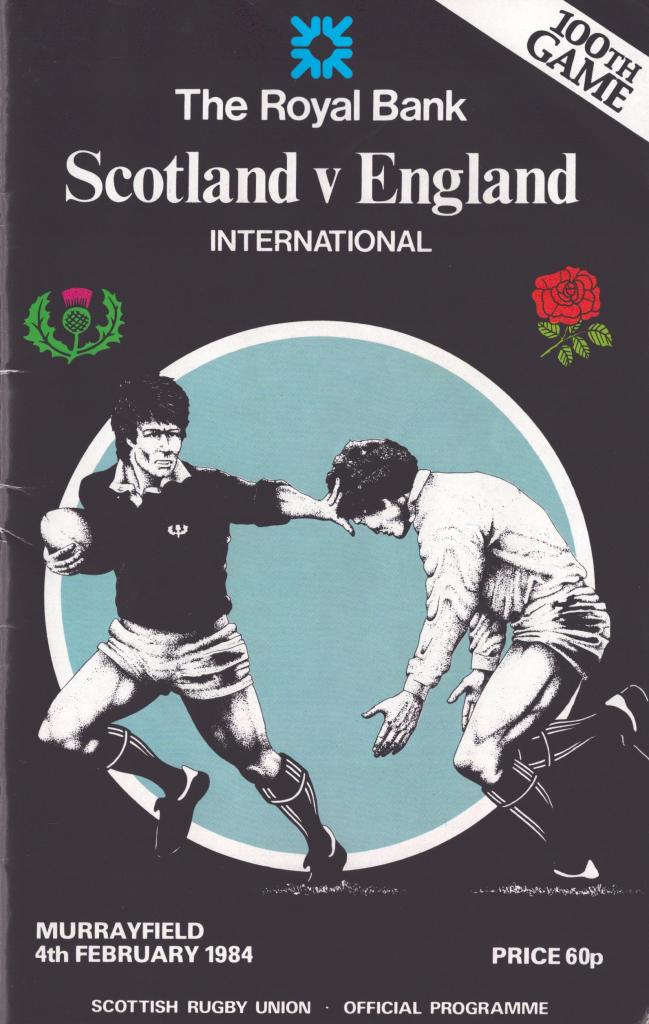
In 1984 Scotland and England celebrated their 100th match, a game in which Scotland repeated the success of 1925 to achieve the Triple Crown. Scotland’s last championship win took place in 1999 during the Five Nations. Scotland is yet to win the Six Nations, and in 100 years’ time, no doubt Murrayfield and the Scotland rugby team will have many more triumphs to celebrate.
Kirsty McNaught, Customer Services Officer
Alasdair Coupar, Customer Services Team Leader
Resources/further reading
Primary Sources
- Daily Express, 20 March 1925, ‘Will it be Flodden or Bannockburn’, British Newspaper Archive accessed on 31/01/2025
- Daily Express, London, Monday 23 March 1925 ‘Dog Stops Play’, British Newspaper Archive accessed on 31/01/2025
- Dundee Courier. (Friday 20 March 1925). ‘How to Get to Murrayfield’, British Newspaper Archive accessed on 31/01/2025
- National Records of Scotland, Register of Sasines. Crown Copyright, 1923-02-07, (No.27), 862, CAMPBELL, Archibald Spencer Lindsey, Sir, CAMPBELL Archibald Spencer Lindsey, Sir, Roseburn Street, 6626/27)
Secondary Sources
- Barbarian FC. Herbert Waddell, accessed: 07 February 2025
- Barbarian FC. Our History: The Presidents, accessed: 07 February 2025
- Barnes, David and Burns, Peter. (2022) Behind the Thistle: Playing Rugby for Scotland. Polaris Publishing
- Burns, Peter and Robertson, Rob. (2024). This is Murrayfield: 100 Years of History in 100 Matches. Polaris Publishing
- Finlay, Richard J. (2004) Bannerman, John Macdonald, Baron Bannerman of Kildonan (1901–1969), politician and rugby player. Oxford Dictionary of National Biography, accessed: 05 Feb 2025
- McGilligan, Brendan. (January 28, 2025). ‘What is the Triple Crown and how do you win it in the Six Nations?’, Rugby World
- Scottish Rugby. (3 February 2021). ‘The History of the Calcutta Cup’, accessed: 18 February 2025
- Scottish Sports Hall of Fame. GPS MacPherson, accessed: 07 February 2025
- Six Nations Rugby. (17 February 2025), ‘Calcutta Cup: The Original Championship Rivalry’
- The Edinburgh Academicals Football Club. Club History, accessed: 07 February 2025
- The Edinburgh Academicals Football Club. Our History and Influence of the Game of Rugby Union, accessed on 07 February 2025
- The Glasgow Academical Club. Our History, accessed on 07 February 2025
- Thorburn, A.M.C. (1985) The Scottish Rugby Union: Official History. Edinburgh, The Scottish Rugby Union, William Collins Sons and Company Limited. 37-40.
 Open Book