
Archives hold evidence of many things. Organisations, people, events, transactions and, of course, relationships. While many records can illuminate the actions of people or a chain of events, some give tantalising glimpses that ask more questions than they answer.
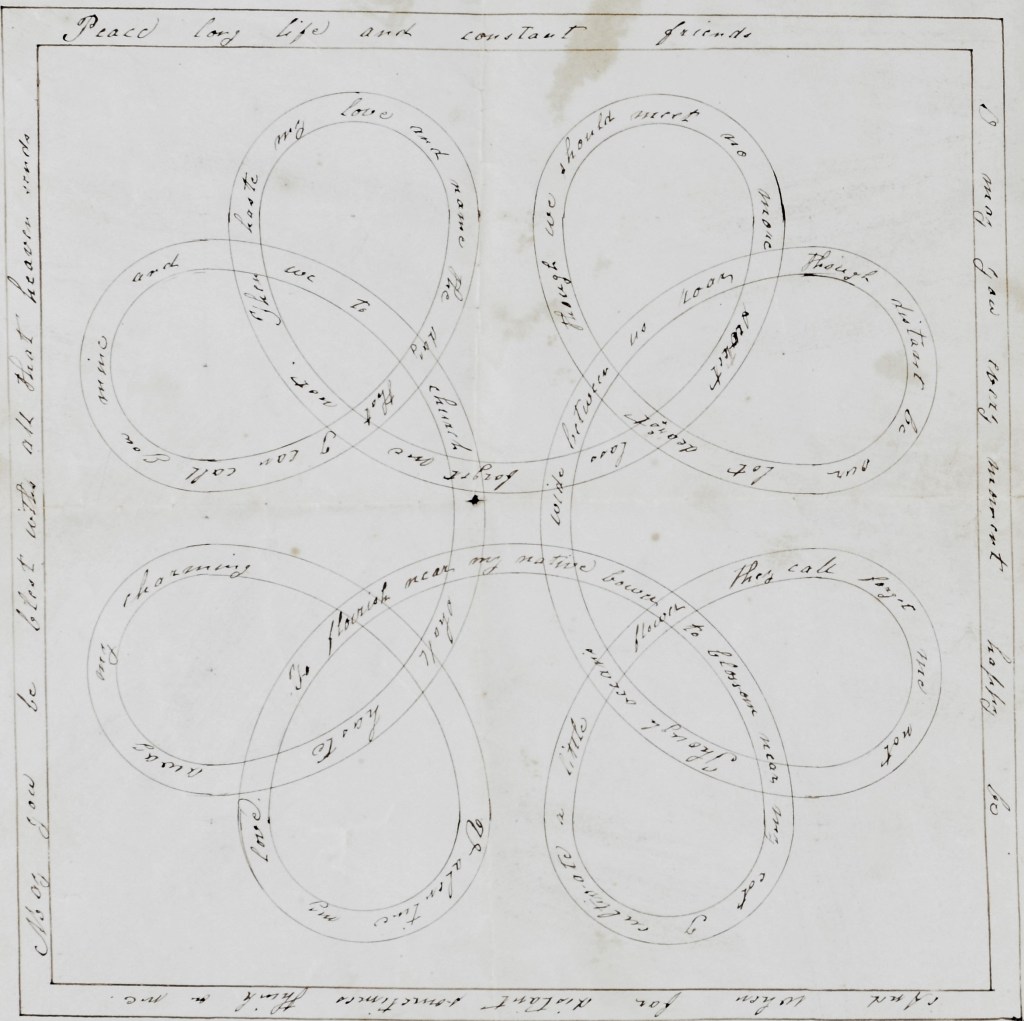
This poem, written inside a never-ending knot, is one of them.
This Valentine’s verse can be found in the miscellaneous papers of James Basley in the National Records of Scotland (NRS). James Basley was a butler who worked for various families in Edinburgh and England. His papers consist primarily of correspondence. This ‘love-knot’ is among:
- An Antenuptial Contract of Marriage between James Weir, gardener, and Janet Somerville, 28 May 1830
- A mutual disposition and settlement, 25 October 1830
- An extract certificate of proclamation of banns and marriage of James Weir and Janet Somerville, 24 & 28 May 1830
The love poem is not addressed or dated, but given the papers it is stored with, it seems likely that it was exchanged between James Weir and Janet Somerville while courting.
The verses read:
Around the outer edge
“May you be blest with all that heaven sends
Peace long life and constant friends
O may you every moment happy be
And when far distant sometimes think on me”In the knot
“To flourish near my native bower
to blossom near my [cot]
I cultivate a little flower
they call forget me not
Though oceans wide between us roar
though distant be our lot dearest
Though we should meet no more
sweet lass forget me not
Then haste my love and name the day
that I can call you mine
and we to church shall haste away
my charming valentine my love.”
What type of poetry is this? Was it common to exchange poems in this form while courting in the 1800s?
It is difficult to say. If this poem was exchanged by James and Janet while courting, we can estimate that it dates between 1820 and the 1830s. The type of poetry seems similar to concrete or pattern poetry, but whether this is a recognised form that was regularly used in the 1800s is less clear.
While no further examples have been identified in the NRS’ archives, there are other similar items elsewhere.
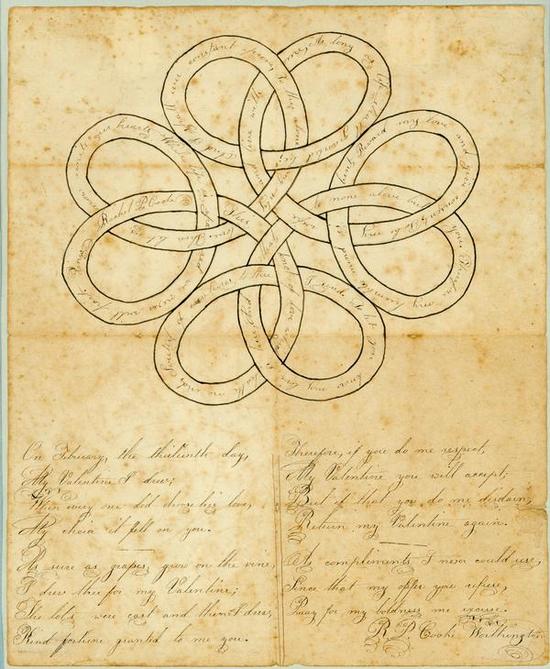
The Worthington Historical Society features a Valentine’s love-knot poem written by Rachel P. Cooke and sent to George Harlow Griswold in 1815. This poem has the same shape as the example in the NRS.
A more ornate example can be found in the Library of Philadelphia from c.1850. See ‘A True Lover’s Knot’.

From these, it seems likely that this was a recognised form of exchange between couples. Whether it was common remains a mystery.
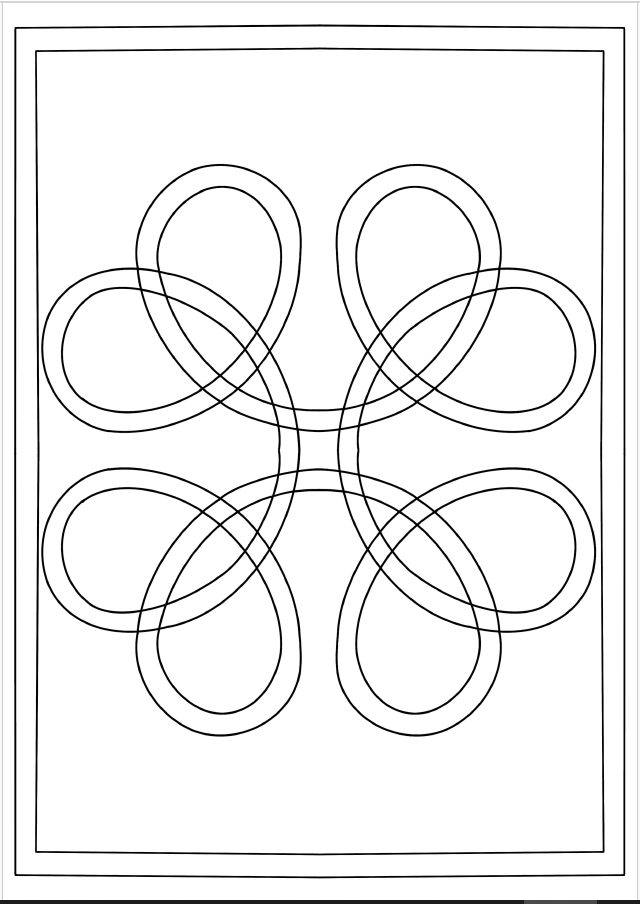
For Valentine’s Day, why not try your hand at writing a love-poem? You can download a template here.
Jocelyn Grant
Archivist
 Open Book