
Did Thamboo know that the revolver was loaded? That was the question which centred around the prisoner’s case when it came to The High Court of Justiciary, Edinburgh, in April 1902.
Thamboo (also known as Thumby or Thumby Joseph) was a 24 year old messroom steward on board the Steamship Ava when it arrived on 7th February 1902 in Princes Dock, Glasgow, Berth 12. Born in Bangalore, India, he moved to Rangoon (today known as Yangon, Myanmar) with his father, two sisters and a brother. Thamboo, who could speak multiple languages, joined the British and Burmese Steamship Navigation Company in around 1897 before joining the SS Ava in 1901. His duties on that vessel were to attend to the engineer’s and officer’s needs.
Amongst the other members of the crew was cook Matthew Fravies, aged around 35 years old. He joined the ship at Rangoon. The two men had become good friends on the nine month voyage to Scotland. Indeed, Thamboo was considered to always attend ‘very well to his duties and the officers could not have a more civil, quiet and obliging servant. He was a hard worker and generally liked on the vessel’. (AD15/02/8)
It was a surprising turn of events when, on the evening of 8th February, Thamboo ‘did discharge at [Fravies] a revolver loaded with ball cartridge’.
What led to the shooting? An investigation was held to find out whether Thamboo ‘did shoot him and did murder [Fravies]’ in a deliberate act, or whether his actions were accident. (JC26/1902/93)
The witnesses
Donald Grant was a watchman employed to mind the SS Ava. He witnessed Thamboo and Fravies arguing in the galley on the main deck. Both men were arguing in a foreign language and Grant was unable to understand the disagreement. He saw Fravies catch Thamboo by the neck, throw him down and hit his body with his fists. Thamboo struggled free and ran out of the galley.
James Brown Crowder was the third officer onboard. Awakening from sleep he had heard a noise in the galley and gone to investigate. He found Fravies lying dead on deck and surrounded by four or five policemen.
Malcolm McLellan, a constable in the Marine Division, was one of the policemen that Crowder saw on board. Crowder noted that immediately after hearing of the affair he found Thamboo in a very excited state, and asking McLellan: “Did you come for me?”. Thamboo quickly admitted guilt, “I did it. I shot the man”.
The weapon
Fravies was shot with a revolver. Stored on a shelf in Crowder’s room it was last used in Rangoon. This was also where Thamboo had last seen it. On being questioned, Crowder couldn’t remember if he had left it loaded, but was under the impression that two or three chambers contained bullets. Upon examination it was found to have five barrels with five empty cartridges.
A doctor was at once summoned and on arrival confirmed Fravies to be dead.

Crown copyright, Crown Office Precognitions (20th Century), AD15/02/8
A post-mortem was carried out on the deceased’s body by Professor John Glaister and Dr Devon . They recorded that Fravies was a fairly vigorous and muscular man. He had marks of blood on his body, lower lip and chin although the only external mark of violence was a small, oval-shaped wound on the left side of the neck, surrounded by bruising. An internal examination found that a bullet had passed internally through the neck with a slight downward trajectory. This had led to a haemorrhage in the left cavity of the chest caused by the penetrating wound.
The bullet was removed and retained. Weighing 83 grams, it had become flattened and distorted in shape due to the force of it travelling through the tissues.
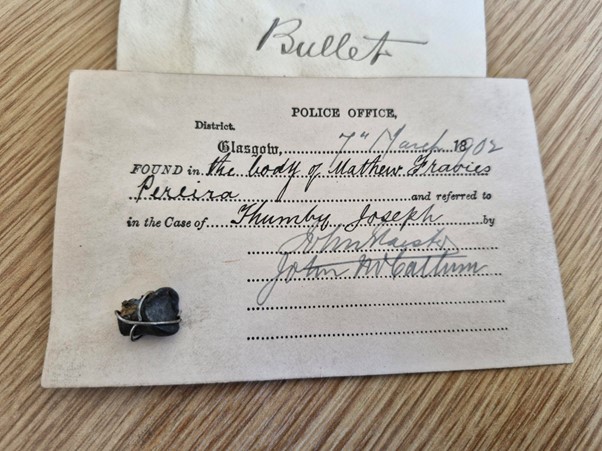
Crown copyright, Crown Office Precognitions (20th Century), AD15/02/8
Thamboo was taken before the Marine Police Court before being committed to prison for further enquiry and to make his declaration. He stated that on the afternoon of 8th February 1902 he was asked to take the ship doctor’s bag to the Central Station, which he did, taking the steward’s key with him. On his return he found Fravies waiting and angry that he had left with the key. In his statement, Thamboo recalled that he had been in the galley eating his dinner when Fravies came in and ‘began to use bad language’. The cook, he said, was a strong man and he began to kick and strike him with his fists.
Frightened, Thamboo called out to Donald Grant (the watchman) to get the police and the third mate, but Grant had laughed at him. After struggling free, he ran to the third mate’s room to report the matter but found him sleeping. Not wanting to wake him, he took the revolver, thinking it was empty, to frighten the cook. Returning to the galley he held the revolver in his right hand, and began hitting it off the palm of his left. Thamboo warned Fravies ‘I am a small man, do not come and knock me another time, or I’ll report you to the chief steward.’ Whilst tapping the revolver on his hand, it went off, and the bullet grazed the forefinger on his left hand. Thamboo maintained that he did not mean to shoot the cook. He had thought the revolver was empty.
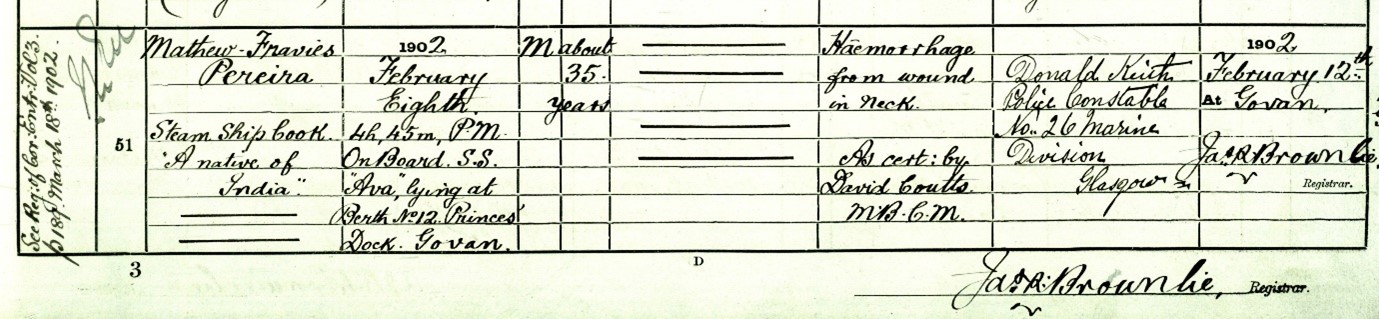
Mathew Fravies’ death is recorded in the Statutory Register of Deaths (his name is given here as Mathew Fravies Pereira). The notes in the margin inform us that further investigation into his death (as undertaken in the post-mortem report) can be found in the Register of Corrected Entries:
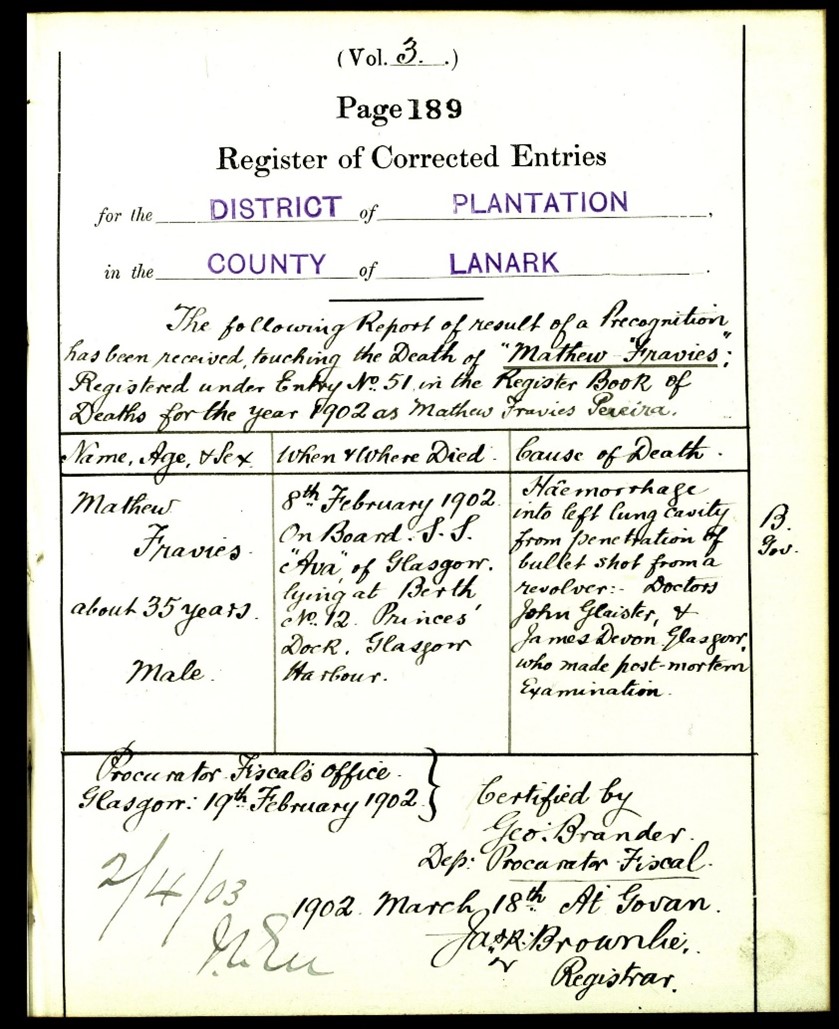
Crown copyright, NRS, 646/01 003 189
After witnesses were examined, Counsel then addressed the jury. Mr Orr, defending Thamboo, submitted that it was a case of accidental shooting. He argued that the extreme provocation suffered by the prisoner and his instantaneous retaliation brought the crime under the category of culpable homicide.
The prosecution reminded the jury that they could only view the event as a pure accident if they believed that the prisoner had not known the revolver was loaded.
The verdict
The jury retired at 1.50pm. After an absence of 10 minutes they returned a unanimous verdict of ‘guilty of culpable homicide in a lesser degree under provocation’ with a recommendation of leniency to the Court . Mr Orr pleaded for a light sentence. He referred to Thamboo’s previous good character, and read a testimonial which he had received from the captain of the SS Ava in Thamboo’s favour.
Lord Pearson, addressed Thamboo. He stated that in light of Thamboo’s excellent character he was sorry to have to pronounce sentence upon him. He noted that Thamboo had done his work well, and been a favourite with all on board the ship. However, he had not controlled his emotions, and a loss of life had resulted from his actions. A sentence of three years’ penal servitude was pronounced.
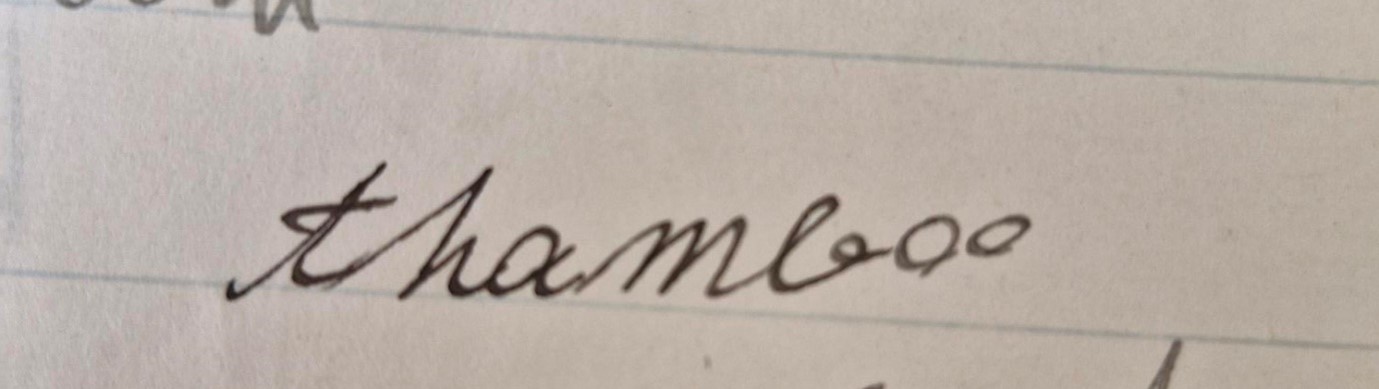
Crown copyright, Crown Office Precognitions (20th Century), AD15/02/8
At this time it is not clear what happened to Thamboo after his release from prison.
This article was researched using High Court of Justiciary records held in NRS and records on Scotland’s People.
To find out more about records we hold, read our research guides and explore the catalogue.
Veronica Schreuder
Outreach and Learning Archivist
 Open Book