
Professor Margaret Fairlie was a leading medical professional in the field of obstetrics and gynaecology. She advocated for and advanced the treatments available for women’s health throughout the first half of the 20th century, and became the first woman to be appointed to a university professorship in Scotland.
She was born to James and Marjory Fairlie, part of a family of well-established farmers in Stotfaulds in the parish of Monikie, Angus, on 30th March 1891. The 1891 census was taken just days after her birth, and she appears there unnamed as ‘under 1 month’. Margaret’s birth was registered by her father when she was two weeks old; recorded as ‘Maggie’ she appears under this name in the 1901 and 1911 census, before becoming known as ‘Margaret’ as an adult.
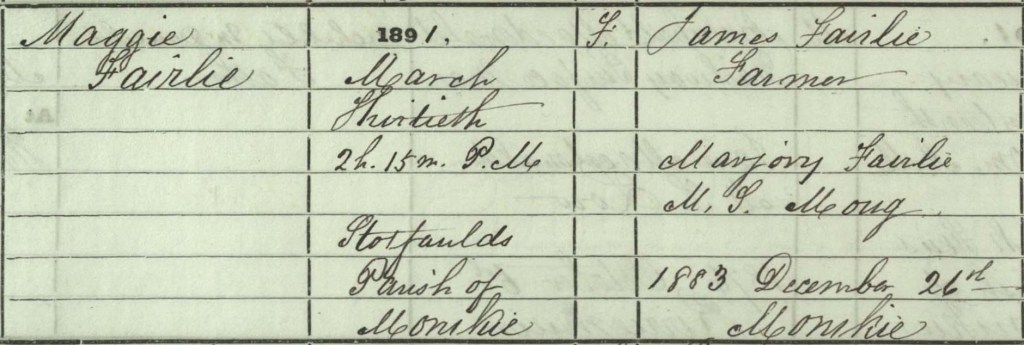
Crown copyright, National Records of Scotland (NRS), Statutory Register of Births, 1891, 311/11 page 4
Educated in various schools including Arbirlot Public School, the Harris Academy in Dundee and Skerry’s College, Margaret progressed to further education at the school of Medicine in Dundee – at that time part of the University of St Andrews – graduating with a Bachelor of Medicine and Surgery in 1915. She later received training in her speciality of obstetrics and gynaecology in St Mary’s Hospital, Manchester.
Margaret worked in a variety of positions including as a house surgeon in the Dundee Royal Infirmary, a visiting gynaecologist to all the hospitals in Angus and the north of Fife, and later in Perth Royal Infirmary and the Sick Children’s Hospital, Edinburgh.
The 1921 census tells us that, by the turn of the new decade, Margaret was living at 168 Nethergate, Dundee, where she was a ‘medical practitioner’ and had begun a consultant practice as an obstetrician and gynaecologist. Margaret worked in Dundee for most of her life.

Crown copyright, NRS, 1921 census, 282/1 5 page 19
Margaret’s career flourished and she devoted her life to improving and championing women’s health. Appointed in 1925 as an obstetrician and gynaecologist at The Dundee Royal Infirmary, the following year she visited the Marie Curie Foundation in Paris. This was the catalyst to her pioneering work in the use of radium in cancer treatment in Scotland, with a focus on malignant gynaecological diseases. Her work in this area went on to inform the development of a predecessor to the modern smear test that is now used to diagnose cervical cancer.
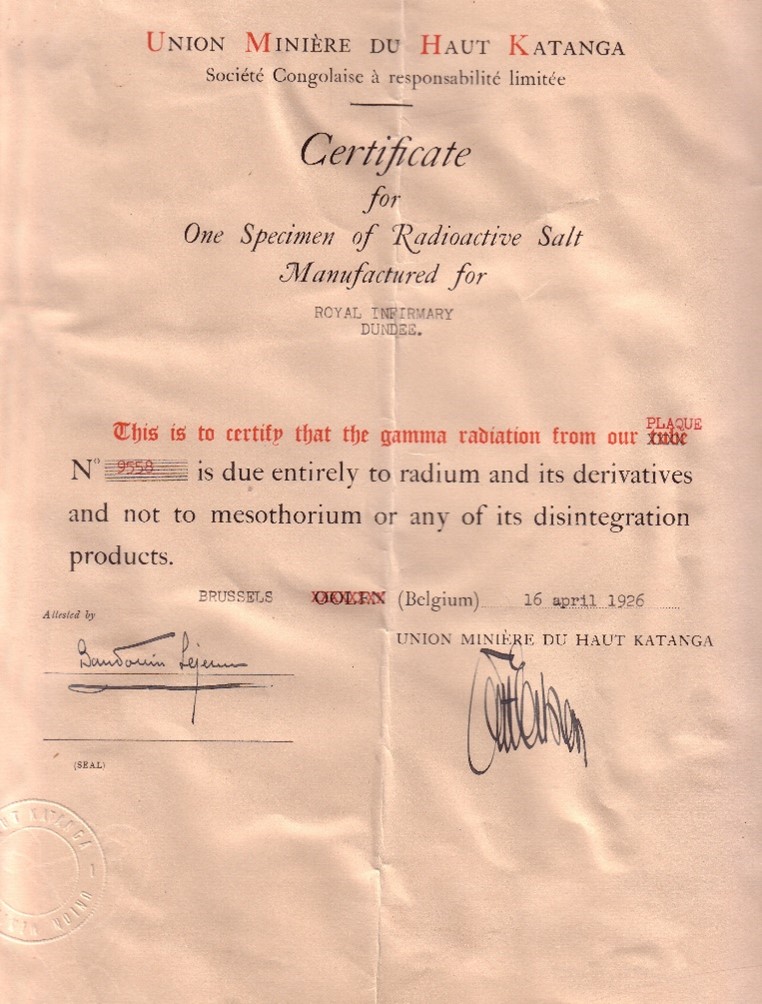
Courtesy of University of Dundee Museums, Tayside Medical History Museum
Despite being a leader in her field, Margaret, at times, faced discrimination due to her sex. In December 1936 she was appointed the medical officer in charge of the department of obstetrics and gynaecology at Dundee Royal Infirmary, following the retirement of her colleague Professor McGibbon. This role should have led to her being appointed Professor of Medical School, but the move was opposed by the University of St Andrews Court; perhaps partly because of ongoing tensions between St Andrews and Dundee, and because of opposition to appointing a female professor. After four years of impasse, the University Court finally granted her the chair, and she was formally installed to the Chair of Midwifery and Gynaecology at St Andrews University on Friday 11th October 1940, becoming the first woman to be appointed to a university professorship in Scotland.
Margaret never married, but had once been engaged to Professor Lloyd Turton Price, a surgeon in Dundee. Cruelly, in February 1933, just before they were due to marry, Professor Price died aged 57 years old. A well-respected surgeon, over 2,000 mourners lamented his death at his funeral.
Professor Margaret Fairlie retired in 1956. At her retiral celebrations Margaret recalled her happy times and great ‘affection for Arbroath Infirmary. I have been happy at my work and I look back with gratitude to the loyalty and friendship I have received from the…staff…I will remember Miss Brander, a former matron, presiding over the tea-cups in the room… where the consultants and doctors discussed problems after a hard day’s work – and, perhaps, gossiped too! Another memory I have is of the superb sunsets seen from the top corridor at the Infirmary where I would pause to look out of the window on my way to an operation about 4pm on an autumn afternoon.’ (The Arbroath Guide, 13th October 1956).

Courtesy of University of Dundee Museums, Tayside Medical History Museum
In her personal time, Margaret enjoyed painting and travelling, exploring South Africa for six weeks in 1952, although she later reflected that in all of her travels she had seen nothing to rival the autumn colouring seen during early October in Perthshire. It was during a trip to Florence, Italy, that Margaret became unwell in the summer of 1963. She returned to Scotland where she was admitted to her old workplace, The Royal Infirmary, Dundee. She died there on 12th July.
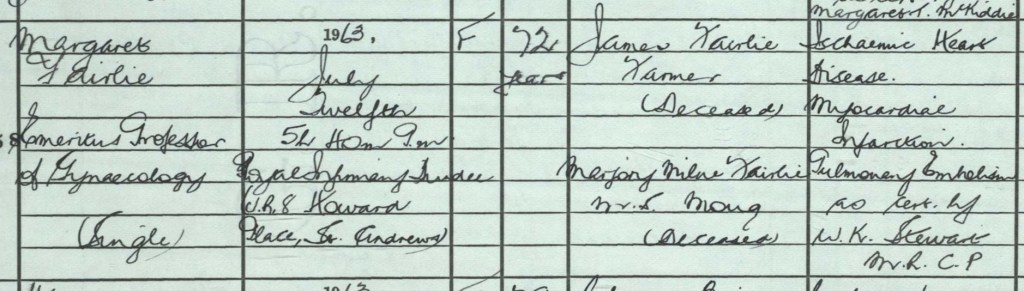
Crown copyright, NRS, Statutory Register of Deaths, 1963, 282/2 758 page 253.
Margaret is remembered by two plaques: one by the gates of the former Dundee Royal Infirmary, which forms part of Dundee’s Women’s Trail, and on Discovery Walk in Slessor Gardens on Dundee’s Waterfront with the words from a former patient ‘She gave me the will to live’.
Veronica Schreuder
Outreach Archivist
With thanks to University of Dundee for their permission to include images from their collection.
A longer version of this article is due to be published in the summer 2024 edition of History Scotland magazine. Find out more at www.historyscotland.com.
 Open Book
So proud to read this entry for my great aunt! I remember visiting her once in Dundee when I was about 12 and she made me try on her university gown in front of a long mirror and told me to work hard at school so I could go to university like her! Hopefully I have lived up to her expectations!
LikeLike
Following his return from the First World War, my late grandfather worked for many years for Doctor Margaret Fairlie as her chauffeur and general handy-man at her home, “Pine Grove” on the Perth Road, Dundee. She was a very well respected lady. In those days, employees in these grand houses were usually referred to by their surname. In my grandfather case, his Surname was Purgavie, and his first name Lindsay. Doctor Margaret Fairlie decided that his surname was too unusual for her to use in front of her friends and so he was always referred to as “Lindsay”.
LikeLike